
オアスペ | 宇宙論と予言の書
第7章
Chapter VII
ひと目でわかる超要約「宇宙論と予言の書 第7章」の要点
この章の要約・解説宇宙論と予言の書 第7章(全37段落)――物体の知識に基づく哲学が、見えないものについて、また地球から遠い惑星について、真理を示すことはできないことを示したので、学ぶ者を、すべての物体のもの、一般的で重要な部分と… 図版61――オラクネブアガラ 2340――十二の変化。
節ごとの構成と要点(全4節)
- 物体の知識に基づく哲学が第1〜9節
物体の知識に基づく哲学が、見えないものについて、また地球から遠い惑星について、真理を示すことはできないことを示したので、学ぶ者を、すべての物体のもの、一般的で重要な部分と… ある時期には、何百年ものあいだ、国々は平和のうちに住み、徳において高まった。それから内部で戦争に転じ、死へと沈んだ。 人がこれ…
- 前に示したように(図版を含む)第10〜18段
前に示したように、地球へと永遠に向かい、地球から永遠に逃れ出る、陽と陰の力がある。これらがなければ、どんな生き物も地上で生きることはできないであろう。 物体の世界は、定まった軌道と用途をもって組織されているが、見えない世界は何ものでもない、あるいはせいぜい組織されていない、と言うのは誤りであ… 図版…
- 図版61――オラクネブアガラ第19〜27段
図版61――オラクネブアガラ 2274、821――七つの変化。すなわち、Howt、oat、bun、lis、vu、mi、ruth。 1245――八つの変化。すなわち、Woo、gosa、lo、galeb、nor、nu、dhi、yun。
- 1790――六つの変化第28〜36段
1790――六つの変化。すなわち、Loo、chong、ouk、chan、clips、wis。 3601――三つの変化。すなわち、H'ak、ghi、kong。 2340――十二の変化。
用語・象徴の読み方
- ダン(Dan)とダンハ(Dan’ha)
- 地球が約3,000年ごとに通過するエセレアの光の帯域(周期)と、その極点にあたる霊的覚醒の時代。
- コーポル(Corpor / 物質界)
- 長さと幅と厚みを持ち感覚で知覚できる物体の世界。地上の肉体を持つ人間は「コーポレアン」と呼ばれる。
- アトモスフェレア(Atmospherea / 下部天界・ハダ)
- 地球を取り巻き地球と共に回転する霊的な大気圏(下部天界)。地上を去った死者の霊が最初に住まう領域。
- エセレア(Etherea / 高次宇宙霊界)
- 諸惑星の霊的大気圏(アトモスフェレア)の外側に広がる、星々の間の高次の光明世界。溶媒たる「エセ(Ethe)」に満ち、涅槃(ニルヴァーナ)の領域を含む。
Chapter VII
第7章
1. HAVING shown the impossibility of philosophy based on corporeal knowledge to demonstrate truth in regard to unseen things, and in regard to planets distant from the earth, it becometh a part of these revelations to put the student in the way to learn from the unseen forces which govern all corporeal things, man included, as a general and important part.
1. 物体の知識に基づく哲学が、見えないものについて、また地球から遠い惑星について、真理を示すことはできないことを示したので、学ぶ者を、すべての物体のもの、一般的で重要な部分として人間をも含めて、それらを支配する見えない力から学ぶ道に置くことが、これらの啓示の一部となる。
2. When a heavy stone falleth on a man and holdeth him down, it is sufficient to say the stone ruleth over the man. If an epidemic come upon a city because of uncleanness, it is well to consider that cause also. Nevertheless, if an epidemic be periodical to a certain city, even when not unclean, it is wise to prophesy an unseen cause. The p. 584 same rule applieth in comparing one locality with another.
2. 重い石が人の上に落ちて彼を押さえつけるとき、石がその人を支配していると言えば足りる。不潔のために疫病がある都市に臨むなら、その原因も考えるのはよいことである。それでも、ある都市に、不潔でないときにさえ疫病が周期的に起こるなら、見えない原因を予言するのが賢明である。(584頁)同じ規則が、ある地域を別の地域と比べるときにも当てはまる。
3. In certain regions of the earth, certain diseases are common; in certain times of the earth, as to cycles of three thousand years, certain diseases were common. In certain places of the earth man hath at times, thousands of years ago, attained to great knowledge and virtue. But his whole country in after centuries became a wilderness.
3. 地上のある地域では、ある病気がよく見られる。地上のある時代には、三千年の周期に関して、ある病気がよく見られた。地上のある場所では、人はかつて、何千年も前に、大いなる知識と徳に達した。しかし後の世紀には、彼の国全体が荒野となった。
4. It is not the place of a prophet to answer these things by the accusation of ignorance or war. The prophet must account for that tendency in man to fall into ignorance and into war. In other words, he must find the cause of causes.
4. これらのことに、無知や戦争を責めることで答えるのは、預言者の役目ではない。預言者は、人が無知と戦争に陥るその傾向を説明しなければならない。言い換えれば、彼は原因の原因を見いださなければならない。
5. At certain periods of time, for hundreds of years, nations have dwelt in peace, and have risen in virtue; then turned to war within themselves and gone down in death.
5. ある時期には、何百年ものあいだ、国々は平和のうちに住み、徳において高まった。それから内部で戦争に転じ、死へと沈んだ。
6. The prophets of old divided time into cycles of three thousand years, with slight variations. And they found that at such periods of time, some certain impulse came upon the people, causing them to try to be better and wiser. Even as the same feeling is this day manifesting itself in many nations.
6. 昔の預言者たちは、わずかな変動を伴う三千年の周期に時を分けた。そして彼らは、そのような時期に、ある衝動が人々に臨み、より良く、より賢くなろうとさせることを見いだした。まさに同じ感情が、今日、多くの国々に現れているように。
7. The scale then riseth for four hundred years, more or less; and, after that, wars and epidemics come upon the people. They begin then to decline, especially in virtue and peace, but the general intelligence suffereth little for about another six or seven hundred years. After which time they destroy their libraries and records, and reduce themselves to ignorance and vice. Then followeth a darkness of one thousand or more years, with slight intermissions. In other six hundred years the corporeal senses begin to ascend. Self-conceit cometh upon them; they think they are the beginning of wisdom on earth. Then cometh another cycle of light. Angels descend from the unseen worlds. New revelations crop out in every quarter. Inspiration cometh upon mortals, and they go to the opposite extreme; superstition and obedience to unseen influences.
7. それから目盛りは、多かれ少なかれ四百年のあいだ上昇する。そしてその後、戦争と疫病が人々に臨む。そのとき彼らは、とくに徳と平和において衰え始めるが、全体の知性はさらに六百年か七百年ほどのあいだ、ほとんど損なわれない。その時の後、彼らは自分たちの図書館と記録を破壊し、自らを無知と悪徳へと落とす。それから、わずかな中断を伴う千年あるいはそれ以上の闇が続く。さらに六百年のうちに、物体の感覚が上昇し始める。うぬぼれが彼らに臨む。彼らは自分たちが地上における知恵の始まりだと思う。それから、もう一つの光の周期が来る。天使たちが見えない世界から降りてくる。新しい啓示がいたるところに現れる。霊感が死すべき者たちに臨み、彼らは反対の極端、すなわち迷信と見えない影響への服従へと向かう。
8. Such, then, is the general character and behavior of man during a cycle. And he riseth and falleth in all these particulars as regularly as the tides of the ocean.
8. それゆえ、一周期のあいだの人の全体の性格と振る舞いは、このようなものである。そして彼はこれらすべての点において、大洋の潮と同じくらい規則正しく、上がり下がりする。
9. That man may begin to comprehend these things, and learn to classify them so as to rise in wisdom and virtue, and thus overcome these epidemic seasons of cycles, these revelations are chiefly made.
9. 人がこれらのことを理解し始め、それらを分類することを学んで、知恵と徳において高まり、こうして周期のこれらの疫病の季節に打ち勝つことができるように、これらの啓示はおもになされている。
10. As previously shown, there are positive and negative forces forever going to and escaping from the earth. Without these no creature could live on the earth. The negative imparteth to man his corporeal growth, and corporeal desires, passions, and so on.
10. 前に示したように、地球へと永遠に向かい、地球から永遠に逃れ出る、陽と陰の力がある。これらがなければ、どんな生き物も地上で生きることはできないであろう。陰は人に、その物体の成長と、物体の欲望、情念などを与える。
11. According to the corpor solutions in the firmament and their precipitations to the earth, as to quantity and quality, so will man be affected and inclined to manifest. These influences are easily discernible by some persons. One is depressed by a dull day; another inclined to drunkenness and fighting. By a bright day man is inspired to energy.
11. 天空の中のコーポルの溶液と、その地への降下の、量と質に応じて、人は影響を受け、それを現す傾きを持つ。これらの影響は、ある人々にはたやすく見分けられる。ある人はどんよりした日に気がふさぐ。別の人は酒浸りと喧嘩に傾く。明るい日によって、人は活力へと駆り立てられる。
12. A su'is is so susceptible to vortexian currents, he can realize the qualities of a medicine whilst it is yet in a glass bottle, by merely holding it in his hand; or know the character of the writer of a letter by holding the letter in his hand. Yet all this is accomplished by the vortexian current of the article in question.
12. スイスは渦の流れに非常に感じやすいので、薬がまだガラスの瓶の中にあるうちに、ただそれを手に持つだけでその性質を知ることができる。あるいは手紙を手に持つことによって、その手紙を書いた者の性格を知ることができる。それでも、これはすべて、問題の品物の渦の流れによって成し遂げられるのである。
13. These revelations however are not in reference to individuals, but to nations and peoples, in periods of time embracing hundreds of years, and thousands of years.
13. しかしこれらの啓示は、個人に関するものではなく、何百年、何千年にわたる時期における、国々と民に関するものである。
14. It is an error to say whilst the corporeal worlds are organized, with fixed orbits and uses, the unseen worlds are nothing, or at best not organized. They are organized, with orbits, places, forms, figures, and so on, as definitely as are the corporeal worlds. Their times and seasons are regular and well provided.
14. 物体の世界は、定まった軌道と用途をもって組織されているが、見えない世界は何ものでもない、あるいはせいぜい組織されていない、と言うのは誤りである。それらは、物体の世界と同じくらい明確に、軌道、場所、形、姿などをもって組織されている。その時と季節は規則正しく、よく備えられている。
15. In the passage of the earth in its own roadway, it goeth amongst these etherean and atmospherean worlds regularly; so that the periods of inspiration, and periods of darkness, are not haphazard.
15. 地球がそれ自身の通り道を通過する中で、それはこれらのエセレアとアトモスフェレアの世界のあいだを規則正しく進む。そのため、霊感の時期と闇の時期は、でたらめなものではない。
16. It is not the purpose of these revelations to work out prophecies, leaving nothing for man to do. But to call his attention to the unseen forces that rule on the earth, and show him the way to make the prophecies himself.
16. 予言を作り上げて、人に何もすることを残さないことは、これらの啓示の目的ではない。そうではなく、地上を支配する見えない力に彼の注意を向け、彼が自分で予言をする道を示すことが目的である。
17. In orachnebuahgalah the student will draw a curved line, representing the travel of the great serpent for three thousand years. This shall be cut across in eight places, to represent the periods of light. The places between them shall be made dark and light according to the history of man's behavior during said three thousand years. War shall be represented by black. The duration of wars shall be marked with a cut called change. Numbers shall designate the degrees of historical manifestations. For every great division of the earth make one orachnebuahgalah. The scale should be p. 585 from one to a thousand for the entire length; and from one to a thousand from one dawn to another, and from one to a thousand for each and every characteristic designated. Number man 1 and 33, and the moon 1 and 18; and number the earth 1 and 365. These were called by the ancients the grades of a thousand (So-e-cen-ti).
17. オラクネブアガラにおいて、学ぶ者は、三千年のあいだの大いなる蛇の旅を表す曲線を描け。これを八か所で横切り、光の時期を表すようにせよ。その間の場所は、その三千年のあいだの人の振る舞いの歴史に従って、暗く、また明るくせよ。戦争は黒で表せ。戦争の続いた期間は、変化と呼ばれる切れ目で印をつけよ。数字は、歴史上の現れの度合いを示すものとせよ。地上の大きな地域ごとに、オラクネブアガラを一つ作れ。目盛りは(585頁)全長について一から千まで、一つの夜明けから次の夜明けまで一から千まで、そして示したひとつひとつの特徴について一から千までとすべきである。人を1と33、月を1と18とし、地球を1と365とせよ。これらは古代の人々によって、千の段階(ソ・エ・セン・ティ)と呼ばれた。
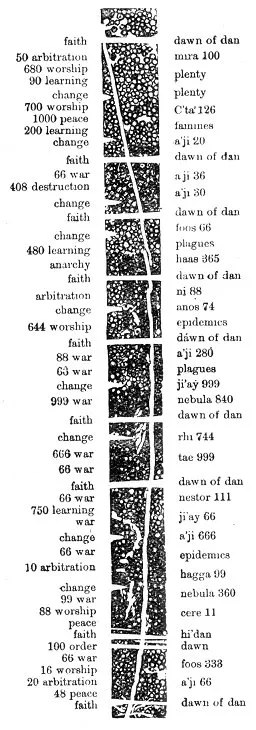
Plate 61.--ORACHNEBUAHGALAH.
図版61――オラクネブアガラ
18. These periods will be found to come under certain numbers, 11, 33, 66, 99, 100, 200, 400, 666, 333, 66, 18, 500, 600, 365, 99, 33, 18, and so on. (Not that the numbers, as such, have anything to do with such matters.) Thus, the moon's time is 18, the earth's 365, a generation 33, dan 200, 400, 600, 500; nitrogen or darkness 66 and 666, and so on. For which reason the following tables of times and measurements were established:
18. これらの時期は、ある数の下に来ることが見いだされるであろう。11、33、66、99、100、200、400、666、333、66、18、500、600、365、99、33、18などである。(数そのものがそのような事柄に何か関わりがあるというのではない。)こうして、月の時は18、地球の時は365、一世代は33、ダンは200、400、600、500、窒素あるいは闇は66と666などである。この理由で、次の時と測定の表が定められた。
Ain, 16. Alia, 248. Anos, 74. Atu, 441. Alex, 11. Alef, 100. Abram, 9. Airi, 36. Ba, 467. Bais, 74. Beth, 999. Braahen, 99. Boi, 476. Ban, 666. Cere, 11. Ceres, 111. Ceret, 112. Ceriv, 48. Cra, 98. C'ta, 126. Dhu, 69. Dhi, 408. Driviis, 6. Dian, 244. Diais, 240. Die, 100. Etus, 42. Earas, 80. Eta, 344. Edith, 111. Emon, 44. Emmon, 444. Feis, 11. Foe, 666. Foor, 333. Goe, 400. Gow, 600. Gow, 500. Gow, 200. Gow, 111. Gu, 888. Ha, 10. Hai, 110. Haa, 120. Hawh, 464. Hy, 964. Hi, 666. Ham, 7. Ho, 999. Hoho, 99. H'ho, 9. Hagar, 33. Hag, 11. Hagga, 99. Haig, 18. Haas, 365. Hoi, 12. Hooh, 200. Hoit, 950. Ine, 27. Ines, 274. Itu, 674. Ka, 6. Kabal, 66. Kaballa, 666. Kaax, 33. Ki, 4. Kii, 999. Kisiv, 18. Loo, 999. Lo, 11. Loos, 33. Loos, 66. Loos, 666. Lu, 10. Lulu, 100. Lens, 200. Mas, 1. Mas, 4. Mas, 18. Ma, 600. Mat, 500. Mi, 1. Mara, 66. Mira, 100. Mithra, 666. Mieuse, 40. Ni, 88. Ni, 888. Niiv, 846. Nes, 11. p. 586 Nestor, 111. Nice, 33. Nu, 880. Nyi, 500. Oh, 1. Oho, 33. Oise, 91. Oise, 991. Pneu, 9. P'euta, 8. Ra, 44. Rhi, 744. Ras, 600. Rus, 400. Rufus, 66. Su, 248. Su'is, 999. Si, 16. Sa, 441. Tae, 999. Tae, 666. Ti, 33. Tus, 18. Vri, 111. Zed, 66. Zudu, 4. Zedeki, 44.
Ain、16。 Alia、248。 Anos、74。 Atu、441。 Alex、11。 Alef、100。 Abram、9。 Airi、36。 Ba、467。 Bais、74。 Beth、999。 Braahen、99。 Boi、476。 Ban、666。 Cere、11。 Ceres、111。 Ceret、112。 Ceriv、48。 Cra、98。 C'ta、126。 Dhu、69。 Dhi、408。 Driviis、6。 Dian、244。 Diais、240。 Die、100。 Etus、42。 Earas、80。 Eta、344。 Edith、111。 Emon、44。 Emmon、444。 Feis、11。 Foe、666。 Foor、333。 Goe、400。 Gow、600。 Gow、500。 Gow、200。 Gow、111。 Gu、888。 Ha、10。 Hai、110。 Haa、120。 Hawh、464。 Hy、964。 Hi、666。 Ham、7。 Ho、999。 Hoho、99。 H'ho、9。 Hagar、33。 Hag、11。 Hagga、99。 Haig、18。 Haas、365。 Hoi、12。 Hooh、200。 Hoit、950。 Ine、27。 Ines、274。 Itu、674。 Ka、6。 Kabal、66。 Kaballa、666。 Kaax、33。 Ki、4。 Kii、999。 Kisiv、18。 Loo、999。 Lo、11。 Loos、33。 Loos、66。 Loos、666。 Lu、10。 Lulu、100。 Lens、200。 Mas、1。 Mas、4。 Mas、18。 Ma、600。 Mat、500。 Mi、1。 Mara、66。 Mira、100。 Mithra、666。 Mieuse、40。 Ni、88。 Ni、888。 Niiv、846。 Nes、11。(586頁) Nestor、111。 Nice、33。 Nu、880。 Nyi、500。 Oh、1。 Oho、33。 Oise、91。 Oise、991。 Pneu、9。 P'euta、8。 Ra、44。 Rhi、744。 Ras、600。 Rus、400。 Rufus、66。 Su、248。 Su'is、999。 Si、16。 Sa、441。 Tae、999。 Tae、666。 Ti、33。 Tus、18。 Vri、111。 Zed、66。 Zudu、4。 Zedeki、44。
YA-LA-PESTA.
ヤ・ラ・ペスタ
2274, 821--Seven changes, i.e., Howt, oat, bun, lis, vu, mi, ruth.
2274、821――七つの変化。すなわち、Howt、oat、bun、lis、vu、mi、ruth。
4750--Nista, six changes, i.e., wuts, norse, rue, wi, rill and goe.
4750――Nista、六つの変化。すなわち、wuts、norse、rue、wi、rill、goe。
1060--Two changes: Aont and foe.
1060――二つの変化。すなわち、Aont、foe。
1768--Four changes: Mathai, yam, luke and jon.
1768――四つの変化。すなわち、Mathai、yam、luke、jon。
1245--Eight changes: Woo, gosa, lo, galeb, nor, nu, dhi and yun.
1245――八つの変化。すなわち、Woo、gosa、lo、galeb、nor、nu、dhi、yun。
1790--Six changes: Loo, chong, ouk, chan, clips and wis.
1790――六つの変化。すなわち、Loo、chong、ouk、chan、clips、wis。
108--Two changes: Yissain and C'tarin.
108――二つの変化。すなわち、Yissain、C'tarin。
3644--Twelve changes: Yats, rope, sum, div, hong, ras, rak, nir, yute, theo, ike and mar.
3644――十二の変化。すなわち、Yats、rope、sum、div、hong、ras、rak、nir、yute、theo、ike、mar。
1746--Eleven changes: Zi, yu, che, gow, rom, luts, wang, said, do, gos and yun.
1746――十一の変化。すなわち、Zi、yu、che、gow、rom、luts、wang、said、do、gos、yun。
3601--Three changes: H'ak, ghi and kong.
3601――三つの変化。すなわち、H'ak、ghi、kong。
47--Three changes: Sim, Will and loo.
47――三つの変化。すなわち、Sim、Will、loo。
9278--Four changes: Lai, bom, ross and fur.
9278――四つの変化。すなわち、Lai、bom、ross、fur。
326--Eight changes: Wahes, Yine, Seb, Dhi, Yeniv, gan, li and rak.
326――八つの変化。すなわち、Wahes、Yine、Seb、Dhi、Yeniv、gan、li、rak。
2340--Twelve changes: Mark, hiss, thor, bess, lin, triv, gam, zet, howd, saing, tum and gowtz.
2340――十二の変化。すなわち、Mark、hiss、thor、bess、lin、triv、gam、zet、howd、saing、tum、gowtz。
コメント
まだコメントはありません。
コメントを読み込んでいます…