
オアスペ | サファの書
Biene の書板
Tablet of Biene
ひと目でわかる超要約「Biene の書板」の要点
この章の要約・解説サファの書「Biene の書板」(全37段落)――A'SU(パン語)。原初の状態にある人。言葉を用いる前、集まる前の。ごく幼い子ども。表現の言葉を一つも知らない者。 Vil または Vril(パン語)。抽象における、すなわちそれ自体としての地の望み。 O'ag(パン語)。下へ、書かれたしるし。
節ごとの構成と要点(全4節)
- A'SU(パン語)第1〜9節
A'SU(パン語)。原初の状態にある人。言葉を用いる前、集まる前の。ごく幼い子ども。表現の言葉を一つも知らない者。 Ugh'gad または U'ghad(パン語)。ある Ghad(神)を打ち立てるための戦争。 Iga(パン語)。Ego(ラテン語)。I、myself(英語、私、私自身)。目と耳の横顔。
- Om(パン語)(図版を含む)第10〜13節
Om(パン語)。ジェホヴィの陰の面。女性のもの。投げ出すものは陽である。受け入れるものは Tae(パン語)。代表となる人。人類の普遍の祈り。また、地の周期のためにエセレアの霊たちによって選ばれる者。 Yi(パン語)。中空の三日月。知恵の標章。大祭司によって授けられる誉れの記章(ヴェーデ語)。
- I'yi(パン語)第14〜22節
I'yi(パン語)。それ自体としての命。I'yii(ゼルル語)。Chiy(ガウ)。Ka'y(フス語)。 Sow(パン語)。足。価値の象徴。 Iod または Ghad または God(パン語)。像または形。太陽の下のどんなものにも似ていない女の像(ポイト語)。
- Oan(パン語)第23〜30節
Oan(パン語)。人だけへの信仰。しるし、互いにもたれ合う二人の人。知性において上ったが、エスにおいては上っていない人々。 Yom(パン語)。異教徒が Om を表すために作った偶像(ヴェーデ語)。Yom、冒涜的な(フォネセ語)。 O'ag(パン語)。下へ、書かれたしるし。
用語・象徴の読み方
- サファ(Saphah)とパニック語(Panic)
- 太古のパン大陸の言語(パニック語)に由来する聖なる文字・象徴・秘儀の言葉の体系。
- パン大陸(Pan / ウィアガ)
- かつて太平洋に存在した巨大な大陸。霊的退廃と低級霊の充満を浄化するため、2万4千年前のアフの周期に海中に沈められた(大洪水伝承の原型)。
- オシリス(Osiris)
- 当初は高位の神(ジェホヴィの息子)の名であり、のちの下部天界では自らを創造主と偽って崇拝させた反逆の偽神(偽オシリス)の名ともなった。
- ザラトゥストラ(Zarathustra / ゾア・ラアステル)
- 約8,900年前(フラガパッティの周期)のペルシアに生まれたイ・エ・ス(無性・霊媒的聖者)。人類史最古の大立法者としてオーマズド(大霊)の律法を説いた。
Tablet of Biene
ビエネの書板
(Poit.)
(ポイト語)
1. A'SU (Panic). A man in aboriginal state; before he used words; before he congregated. A very young child; one that knows no word of expression. The race of man in its first age, as applied to Corpor (the earth). A'su, the first habitable age. A circle with a central point. According to the place of A'su on the tablets so shall the interpreters understand. (Poit.)
1. A'SU(パン語)。原初の状態にある人。言葉を用いる前、集まる前の。ごく幼い子ども。表現の言葉を一つも知らない者。コーポル(地)に当てられて、その最初の時代にある人の種族。A'su、最初の住みうる時代。中心に点のある円。書板の上での A'su の場所に応じて、解き明かす者たちは理解するであろう(ポイト語)。
2. M'asu (Panic). With words came war. In congregating men, the liberty of one interfered with another. Mas'su (Kii). A circle with the four evil corners. Let no man say, I will not sow on the earth, lest I be bound; but be ye fruitful and multiply; for this is the fullness of earth and heaven. (Abraham.) The symbol of M'asu was given to the married, but to the barren the high priest gave S'pe (Gau). Jehovih said: Call not any man evil; but call ye him unripe fruit (Kosmon). Because man cut himself off from Me and choose war, condemn him not, but deliver ye him (Moses).
2. M'asu(パン語)。言葉と共に戦争が来た。人々が集まることにおいて、一人の自由がほかの者の自由を妨げた。Mas'su(キイ語)。四つの悪い隅を持つ円。誰にも、縛られないように地に種をまかない、と言わせるな。そうではなく、実り、増えよ。これが地と天の満ちあふれだからである(アブラハム)。M'asu の象徴は結婚した者たちに与えられたが、子のない者たちには大祭司は S'pe を与えた(ガウ)。ジェホヴィは言われた。誰をも悪いと呼ぶな。そうではなく、彼を熟していない果実と呼べ(コスモン)。人が我から自分を切り離して戦争を選んだからといって、彼を罪に定めるな。そうではなく、彼を救い出せ(モーセ)。
3. Ex'su (Panic). Nation against nation. A symbol of threat; one king against another. Anra'mainyus sent the symbol of a circle with four cross-corners and a point, over all the earth. (Vede).
3. Ex'su(パン語)。国が国に逆らう。脅しの象徴。一人の王がほかの王に逆らう。アンラ・マイニュスは、四つの交差した隅と一つの点を持つ円の象徴を、全地に送った(ヴェーデ語)。
4. Ugh'sa (Panic). Standing armies. Is not justice accorded to him who is mightiest? (Fus). They not only waged war, but in times of peace they maintain armies ready for more war. Come, therefore, away from them, ye that have faith in Jehovih, and I will deliver you into another country (Abraham). Rather than that ye be impressed in war, come whither I will lead, and dwell in peace (Brahma). A symbol of standing armies (Gau).
4. Ugh'sa(パン語)。常備軍。正義は最も力のある者に与えられるのではないか(フス語)。彼らは戦争をしただけでなく、平和の時にもさらなる戦争に備えた軍隊を保つ。それゆえ、ジェホヴィへの信仰を持つあなたたちは、彼らのもとから去って来よ。そうすれば我はあなたたちを別の国へ救い出すであろう(アブラハム)。戦争に駆り出されるよりも、我が導くところへ来て、平和のうちに住め(ブラフマ)。常備軍の象徴(ガウ)。
5. Ugh'gad or U'ghad (Panic). A war to establish a certain Ghad (God). Ye not only desire to make slaves of men on earth, but to bind them unto your Ghad after death. (Craosha to the druks.) They fight for the king, being his slaves; they fight for their Ghad, being his vermin (Brahma). An evil man saith, I will war for Egypt, for this is my country; but I say unto you, all countries are Jehovih's (Moses). Be not slaves to any country, nor to any king, nor to a Ghad, but serve the Great Spirit. (Abraham.) A nationality, a symbol. (Gau.)
5. Ugh'gad または U'ghad(パン語)。ある Ghad(神)を打ち立てるための戦争。あなたたちは地上で人々を奴隷にすることを望むだけでなく、死後に彼らをあなたたちの Ghad に縛ることを望む(ドゥルクたちへのクラオシャ)。彼らは王の奴隷として王のために戦い、自分たちの Ghad の害虫として Ghad のために戦う(ブラフマ)。悪い人は言う。私はエジプトのために戦争をしよう。ここが私の国だからである、と。しかし我はあなたたちに言う。すべての国はジェホヴィのものである(モーセ)。どんな国の奴隷にも、どんな王の奴隷にも、Ghad の奴隷にもなるな。そうではなく、大いなる霊に仕えよ(アブラハム)。国籍、象徴(ガウ)。
6. Ort'n (Panic). By the sea; or sea-land.
6. Ort'n(パン語)。海辺の、あるいは海の地。
7. Ort'm (Panic). By the forest; or forest-land.
7. Ort'm(パン語)。森のそばの、あるいは森の地。
8. Alef (Panic). A new beginning. Those that were delivered from evil spirits were given Alef as a sign of power (Poit). Alef was a gift of the high priest (Zarathustra). A letter of the Ebra alphabet. When a man desires to reform himself from drunkenness, the Miji gave him Alef, a strengthening symbol (Brahma).
8. Alef(パン語)。新しい始まり。悪い霊たちから救い出された者たちには、力のしるしとして Alef が与えられた(ポイト語)。Alef は大祭司の贈り物であった(ザラトゥストラ)。エブラのアルファベットの一文字。人が酔いから自分を改めることを望むとき、Miji は彼に強める象徴である Alef を与えた(ブラフマ)。
9. Iga (Panic). Ego (Latin). I, myself (English). A profile of the eye and ear. An emblem of the sounds ai and e (Gau), or i and e, or e, or g. Two equivalents to portrait of an eye. In hieroglyphs, a radical.
9. Iga(パン語)。Ego(ラテン語)。I、myself(英語、私、私自身)。目と耳の横顔。ai と e の音の標章(ガウ)、あるいは i と e、あるいは e、あるいは g。目の正面の像に相当する二つのもの。象形文字における語根。
10. Om (Panic). The negative of Jehovih. The female. That that projecteth is positive. That that receiveth
10. Om(パン語)。ジェホヴィの陰の面。女性のもの。投げ出すものは陽である。受け入れるものは
p. 606
606頁
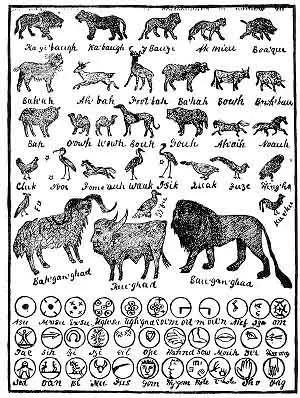
Plate 73.--TABLET OF BIENE.
図版73 ビエネの書板。
p. 607
607頁
is negative (Gau). Let those that desire to receive spiritually ask of Om; and those that go forth in might return thanks to Eolin (Zarathustra). Power cometh not by supplication, but by going forth; spiritual gifts come not by going forth with might, but by waiting in supplication (Brahma). Nevertheless the ALL ONE is but ONE, but with two attributes (Kosmon). Brahma said: O OM, give thou to my soul; O EOLIN, I am going forth to labor; be thou with me. (Vede.) The ever present OM, the ever present ELOIH, said: Two attributes gave I, the All-self, to every man-self, the Om and the Na (negative and positive), that he might hold discourse within himself. (Vede.) In seeking a wife, see to it that OM is her transcendent virtue; otherwise she will be as a thorn in thy side. (Abraham.) Until a man have OM in the ascendent he shall not hear nor see the Great Spirit. (Zarathustra.) Let your young men seek employment that calleth not forth NA, but rather OM. (Brahma.)
陰である(ガウ)。霊において受け入れることを望む者たちには Om に求めさせよ。そして力のうちに出て行く者たちには Eolin に感謝を返させよ(ザラトゥストラ)。力は嘆願によって来るのではなく、出て行くことによって来る。霊の賜物は力をもって出て行くことによって来るのではなく、嘆願のうちに待つことによって来る(ブラフマ)。それにもかかわらず、すべての一なる方はただ一つであるが、二つの属性を持つ(コスモン)。ブラフマは言った。おお、OM よ、私の魂に与えてください。おお、EOLIN よ、私は労働しに出て行きます。私と共にいてください(ヴェーデ語)。常在の OM、常在の ELOIH は言われた。二つの属性を、我、すべての自己は、それぞれの人の自己に与えた。Om と Na(陰と陽)である。彼が自分の内で語り合うことができるように(ヴェーデ語)。妻を求めるにあたっては、OM が彼女の卓越した徳であるよう気をつけよ。さもないと彼女はあなたの脇腹のとげのようになるであろう(アブラハム)。人は OM を優位に持つまで、大いなる霊を聞くことも見ることもないであろう(ザラトゥストラ)。あなたたちの若者には、NA ではなく、むしろ OM を呼び起こす仕事を求めさせよ(ブラフマ)。
11. Tae (Panic). A representative man. The universal prayer of mankind. Also one who is chosen by etherean spirits for an earth cycle; as Zarathustra, Abraham, Brahma, Moses, Capilya, Confucius, etc. I provided for the nations in their darkness, saith Jehovih. For I bring the earth into a light region in the firmament, and I send My etherean angels to deliver them out of darkness and bondage. In My name raise they up men with eyes to see and ears to hear, and I proclaim unto all the inhabitants of the earth (Kosmon). Mankind.
11. Tae(パン語)。代表となる人。人類の普遍の祈り。また、地の周期のためにエセレアの霊たちによって選ばれる者。ザラトゥストラ、アブラハム、ブラフマ、モーセ、カピルヤ、孔子などのように。我は暗さのうちにある諸国のために備えた、とジェホヴィは言われる。我は地を大空の光の領域へと導き入れ、彼らを暗さと束縛から救い出すために我がエセレアの天使たちを送るからである。我が名において、彼らは見る目と聞く耳を持つ人々を起こし、我は地のすべての住民に宣言する(コスモン)。人類。
12. Sih (Panic). One whose faith is low. One whose spirit acknowledgeth the gift of spirits, but not the All Person. Three persons have I found; one believeth only in earthly things (material); one in spirits of the lower heavens (spiritist), and one who hath faith in the All Creator (i.e., the Faithists). (Confucius.) They all rise to the destiny they have chosen. (Confucius.) The worshiper of a Savior is Sih (Vede). The worshiper of a God born of a woman is Sih (Vede). Save a man put away the Sih that is in him he can not rise to My emancipated heavens, saith Jehovih. Save a man put away the Pan (materialism) that is in him, he can not rise even in the lower heavens; but his spirit after death remaineth in his own house, saith Jehovih. A symbol of a horizontal spear.
12. Sih(パン語)。信仰の低い者。その霊が、霊たちの賜物は認めるが、すべての人格を認めない者。我は三種の人を見いだした。一人は地のことだけを信じる(唯物的な者)。一人は下の天々の霊たちを信じる(霊を信じる者)。そして一人はすべての創造者への信仰を持つ(すなわちフェイスィスト)(孔子)。彼らはみな、自分が選んだ行く末へと上る(孔子)。救い主を崇める者は Sih である(ヴェーデ語)。女から生まれた神を崇める者は Sih である(ヴェーデ語)。人が自分の内にある Sih を捨て去らないかぎり、彼は我が解放された天々へと上ることはできない、とジェホヴィは言われる。人が自分の内にある Pan(唯物論)を捨て去らないかぎり、彼は下の天々においてさえ上ることはできず、その霊は死後に自分の家にとどまる、とジェホヴィは言われる。水平の槍の象徴。
13. Yi (Panic). A hollow crescent. Emblem of wisdom. A badge of honor bestowed by a high priest (Vede). One of the sacred sounds in the Vedic language. [Not pronounced Wy, but Yi'h.] Tu'shiy'a (Fonece). Tushiy-yah (Hebrew). The secret pass-word to the dark chamber (Kii).
13. Yi(パン語)。中空の三日月。知恵の標章。大祭司によって授けられる誉れの記章(ヴェーデ語)。ヴェーデの言語における聖なる音の一つ。[Wy ではなく、Yi'h と発音される。]Tu'shiy'a(フォネセ語)。Tushiy-yah(ヘブライ語)。暗い部屋への秘密の合言葉(キイ語)。
14. I'yi (Panic). Life, per se. I'yii (Zerl). Chiy (Gau). Ka'y (Fus). Cha'iy (Fonece). Chai (Ebra). Chai (Hebrew). Tc'yi (Vede). Hy'id'n (Chine). On'yi'h (Algonquin). A tree without substance. Tree of Life. A place of registry; a family record. The origin of I'yi (life), who knoweth? (Panic.) Jehovih said: Infants had gone to heaven before the earth was, and had grown to be wise men and women, but they had not tasted of the fruit of the Tree of Life; and when the earth was ripe unto giving mortal birth to man these angels alighted on the earth. Jehovih said unto them: Eat ye not of the Tree of Life, lest in that day ye become bound to the earth. In that day angels could clothe themselves with corporeal forms by majesty of their own wills, and in innocence they mingled with the people A'SU, who were of the earth, and they were tempted for Wisdom's sake, and did eat of the fruit of the Tree of Life, and they beheld their own nakedness. Jehovih said: By the love ye bear unto your own heirs ye shall be bound to the earth six generations. And it was so. (Abraham.)
14. I'yi(パン語)。それ自体としての命。I'yii(ゼルル語)。Chiy(ガウ)。Ka'y(フス語)。Cha'iy(フォネセ語)。Chai(エブラ語)。Chai(ヘブライ語)。Tc'yi(ヴェーデ語)。Hy'id'n(チネ語)。On'yi'h(アルゴンキン語)。実体のない木。命の木。登録の場所。家族の記録。I'yi(命)の起源を、誰が知っていようか(パン語)。ジェホヴィは言われた。地が存在する前に赤子たちは天へ行き、賢い男と女に成長していたが、彼らは命の木の果実を味わっていなかった。そして地が人を死すべき身に生み出すまでに熟したとき、これらの天使たちは地に降り立った。ジェホヴィは彼らに言われた。命の木から食べるな。その日にあなたたちが地に縛られることがないように。その日、天使たちは自分の意志の威厳によってコーポルの形を身にまとうことができた。そして無垢のうちに、彼らは地のものであった人々 A'SU と交わり、知恵のために誘惑されて、命の木の果実を食べ、自分たちの裸を見た。ジェホヴィは言われた。あなたたちが自分自身の世継ぎに抱く愛によって、あなたたちは六世代のあいだ地に縛られるであろう。そしてそのとおりであった(アブラハム)。
15. Vil or Vril (Panic). Earthly desire in abstract or per se. By indulgence in begetting shall man be bound after death; by not begetting, how shall he know all the earth? (Vede). Earth-desire is not evil, but S'pe shall rule over him (Zarathustra). Earthly inventions being to gratify earthly desires, are they good? (Confucius.) Jehovih saith: Seek to do all possible things; for this reason have I given earthly desires. (Gau.) Shall a man not eat and drink and sleep? Now I say unto you, there is an earth body and a spirit to all men, and whatever ye do unto one for its good, rendereth good to the other, and whatever ye do unto one for its injury, injureth the other also. (Moses.) If the spirit man maketh the corporeal man to move, doth it not also make the desires of the flesh? Is the flesh capable of desire? If so, is not flesh father to spirit?
15. Vil または Vril(パン語)。抽象における、すなわちそれ自体としての地の望み。生むことにふけることによって、人は死後に縛られるであろう。生まないことによって、どうして彼は全地を知るであろうか(ヴェーデ語)。地の望みは悪ではないが、S'pe が彼を治めるであろう(ザラトゥストラ)。地の発明は地の望みを満たすためのものであるが、それらはよいものか(孔子)。ジェホヴィは言われる。可能なすべてのことをしようと努めよ。この理由のために我は地の望みを与えた(ガウ)。人は食べ、飲み、眠らないであろうか。さて、我はあなたたちに言う。すべての人には地の体と霊とがある。そしてあなたたちが一方にその益のためにすることは何であれ、他方にも益をもたらし、あなたたちが一方にその害のためにすることは何であれ、他方をも害する(モーセ)。もし霊の人がコーポルの人を動かすのなら、それは肉の望みをも作るのではないか。肉は望むことができるのか。もしそうなら、肉は霊の父ではないか。
16. Ope (Panic). The central cause; love. By love only moveth any man; even in anger he moveth not but by the love that appeaseth it (Abraham). The All Good, to be (Fonece). Tob (Ebra). OE (Chine). Gu'oe (Algonquin). The good that bringeth together, Hy'yope. (Vede.) If man love not, he would not congregate, and would p. 608 therefore war not. But since he delighteth in war, I will be ruler over him to that end (Anra'mainyus), i.e., satan. Man would not give but because he loveth to do so. What honor, then, shall a man take to himself for helping his neighbor? (Confucius.) Did not the Great Spirit make all things by giving? What but love actuated Him? Wherefore, then, shall man applaud Him? (Confucius.) By glorifying the Father for his love, do we not all grow in love? And is not this the highest virtue? (Confucius.) The fool saith: Why shall I praise the Creator? Had He not gratified His love by creating, then would He not have created. This does not concern me; to find what will make men loving and good toward one another, is that not the greatest wisdom? Therefore I honor the wisdom of the ancients in singing praise to the Creator. (Confucius.) Though a man can not love all men, is it not wise that they who love one another, having some virtues alike, shall become a people unto themselves. (Moses.)
16. Ope(パン語)。中心の原因。愛。ただ愛によってだけ、人は動く。怒りのうちにあってさえ、彼はそれをなだめる愛によるのでなければ動かない(アブラハム)。すべての善、存在すること(フォネセ語)。Tob(エブラ語)。OE(チネ語)。Gu'oe(アルゴンキン語)。引き合わせる善、Hy'yope(ヴェーデ語)。もし人が愛さなければ、彼は集まらず、それゆえ(608頁)戦争もしないであろう。しかし彼は戦争を喜ぶので、我はその目的のために彼の支配者となろう(アンラ・マイニュス)、すなわちサタン。人は、そうすることを愛するのでなければ与えないであろう。それでは、隣人を助けることについて、人はどんな誉れを自分に取るべきであろうか(孔子)。大いなる霊は与えることによってすべてのものを作られたのではないか。愛のほかに何がその方を動かしたであろうか。それでは、なぜ人はその方をほめたたえるべきなのか(孔子)。父をその愛のゆえに栄光づけることによって、私たちはみな愛において成長するのではないか。そしてこれが最も高い徳ではないか(孔子)。愚か者は言う。なぜ私は創造者を賛美すべきなのか。その方が創造することによってその方の愛を満たされなかったなら、その方は創造されなかったであろう、と。これは私に関わりのないことである。人々を互いに愛情深く善いものにするものを見いだすこと、それが最も大きな知恵ではないか。それゆえ私は、創造者に賛美を歌うことにおける古代の者たちの知恵を敬う(孔子)。人はすべての人を愛することはできないが、互いに愛し合い、いくつかの徳を同じように持つ者たちが、自分たちだけで一つの民となることは賢いことではないか(モーセ)。
17. Hah'nd or Han'hd (Panic). A hand (English). A symbol of values.
17. Hah'nd または Han'hd(パン語)。A hand(英語、手)。価値の象徴。
18. Sow (Panic). A foot. A symbol of values.
18. Sow(パン語)。足。価値の象徴。
19. Mouh (Panic). A symbol of values. Mouth (English).
19. Mouh(パン語)。価値の象徴。Mouth(英語、口)。
20. Fi'i (Panic). A symbol of values.
20. Fi'i(パン語)。価値の象徴。
21. Hiss'ong (Panic). A serpent's head and tongue. A symbol of values.
21. Hiss'ong(パン語)。蛇の頭と舌。価値の象徴。
22. Iod or Ghad or God (Panic). A figure or form. A female figure unlike anything under the sun (Poit). Both male and female made they their Iod'ha, and stood them by the roadside (Iz). In the infant age of the world (Iod, God) was made of wood or stone (Gau). In the time of Seffas they placed him in the sky (Gau). Anything that is worshiped, having form or figure (Ceremonies of High Noon). Ghad (Aribania). A man with spirit gifts. Gad or God, a man who denies he had a natural father. In those days the king persuaded the people that their sire was the Unseen Creator, and all the kings were called Gee'od (Vede). Because ye have made idols of kings, calling them Gods, so call ye the All Light God (Abraham). Whoever saith the Incomprehensible is God, blasphemeth before Him. (Zarathustra.) Is He small like a man? (Gau.) They have blasphemed, calling their Iod'a the Elohim, the Creator (Aribania). I say unto you it is equally blasphemous to bring the Mighty One down to form and figure like your God (Heleste). They seek to confound the unlearned by persuading them that Eloih and their god is one and the same person (Fus). Have not many spirits appeared within the temples, saying: I am God, and ye are in my keeping? Yod, a mortal king. Yod'a, king spirit in atmospherea (Gau). As it hath been declared of old so do I now declare unto you, which is, that the lower heavens are next to the earth, and are full of kingdoms, and the kings of these are Gods (Heleste). God, a tyrant in atmospherea; for as a king is on earth, so is a God in the lower heavens, and so is a Lord. Whosoever saith, Before thee, O God, I bow my head, selleth himself to Osiris (Moses.) Whoever amongst you doeth sacrifice to the Lord are of his dominion; suffer none of my people to marry therewith (Abraham). Have not many of the tyrants of I'em (Hades) returned to earth and proclaimed themselves Lord and God? What more testimony requireth any man that none of them are the All Light? Is not E-O-Ih wider than all the earth? (Fus.) We swear unto thee, O Jehovih, that we will not call on the name, nor worship, nor adore any person or thing called God or Lord, but Thee only, O Jehovih. (Moses' ceremonies.) Moses being old, said: Above all things preserve the sacred pass-word, E-O-Ih, inviolate; neither suffer it to come to the unlearned lest they be confounded by the subtlety of the God of the Egyptians. Was it not because the unlearned desired a form or figure to worship that the Lord (Osiris) ruined Egypt, making slaves of the Egyptians, both on earth and in his kingdoms in Haw-we? (The lower heavens.) But that the Levites may be friendly with me suffer them to worship the Lord their God. Moses, being about to give up his soul, said: I feel a thorn pricking my side, and I know it is the Leviticans. They not being eligible to the secret rite (Elohim), will in time to come possess the country and substitute their Lord God for the Great I am, the All Eloi Iod, a stone figure by the roadside without sexual parts, and it is called God (Egypt). Theos and Zeus (Greek and Latin). A being that is worshiped, said to be in the figure of a man. He has a throne in the lower heavens. Dyaus, like the Yod of the ancient idolaters, hath become a king in one of the corners of the lower heavens (Vede). O Om, thou All Present and Boundless, will man on earth ever distinguish? O NAOMA, forms and figures must die! (Vede.) God (English). An idol in heaven said to be in the figure and form of man sitting on a throne. p. 609 He is believed by people in darkness to be the Creator of all things. They ignorantly blaspheme against the Great Spirit, Jehovih (Kosmon), calling Him God.
22. Iod または Ghad または God(パン語)。像または形。太陽の下のどんなものにも似ていない女の像(ポイト語)。男と女の両方を、彼らは自分たちの Iod'ha として作り、それらを道端に立てた(イズ語)。世界の幼年の時代に、(Iod、God)は木か石で作られた(ガウ)。セッファスの時に、彼らは彼を空に置いた(ガウ)。崇められるもので、形または像を持つどんなものも(真昼の儀式)。Ghad(アリバニア語)。霊の賜物を持つ人。Gad または God、自分に生みの父がいたことを否む人。その日々、王は人々に、彼らの祖は見えない創造者であると説き伏せ、すべての王は Gee'od と呼ばれた(ヴェーデ語)。あなたたちは王たちを偶像とし、彼らを神々と呼んだので、そのようにあなたたちはすべての光を神と呼ぶ(アブラハム)。理解を越えた方を神であると言う者は誰でも、その方の前で冒涜している(ザラトゥストラ)。その方は人のように小さいのか(ガウ)。彼らは自分たちの Iod'a を Elohim、創造者と呼んで冒涜した(アリバニア語)。我はあなたたちに言う。力ある方をあなたたちの神のような形と像へと引き下ろすことも等しく冒涜である(ヘレステ)。彼らは、Eloih と自分たちの神が一つの同じ人格であると説き伏せることによって、学びのない者たちを混乱させようとする(フス語)。多くの霊が神殿の内に現れて、我は神であり、あなたたちは我が保護のうちにある、と言わなかったか。Yod、死すべき王。Yod'a、アトモスフェレアにおける王の霊(ガウ)。昔宣言されたとおりに、そのように我は今あなたたちに宣言する。それは、下の天々は地の隣にあり、王国でいっぱいであり、それらの王たちが神々である、ということである(ヘレステ)。神、アトモスフェレアにおける暴君。地上に王がいるように、そのように下の天々には神がおり、そのように主がいるからである。おお、神よ、あなたの前に私は頭を垂れます、と言う者は誰でも、自分をオシリスに売っている(モーセ)。あなたたちのうちで主に犠牲を献げる者は誰でも、彼の支配に属する。我が民の誰にもそれと結婚させるな(アブラハム)。イエム(ハデス)の暴君たちの多くが地に戻って来て、自分を主また神と宣言しなかったか。彼らの誰もすべての光ではないことについて、人はそれ以上のどんな証しを求めるのか。E-O-Ih は全地よりも広いのではないか(フス語)。私たちはあなたに誓います、おお、ジェホヴィよ、私たちは神または主と呼ばれるどんな人格やものの名も呼ばず、崇めず、敬わず、ただあなただけを、おお、ジェホヴィよ(モーセの儀式)。モーセは年老いて言った。何よりも、聖なる合言葉 E-O-Ih を犯されないように保て。またそれが学びのない者たちのもとに来ないようにせよ。彼らがエジプト人の神の巧妙さによって混乱させられることがないように。学びのない者たちが崇めるための形や像を望んだからこそ、主(オシリス)はエジプトを滅ぼし、エジプト人を地上でも、Haw-we(下の天々)にある彼の王国においても奴隷にしたのではなかったか。しかし、レビ人たちが私と友好であることができるように、彼らに彼らの主なる神を崇めさせよ。モーセは魂を委ねようとして言った。私は脇腹を刺すとげを感じる。そして私はそれがレビ人たちであることを知っている。彼らは秘密の儀礼(Elohim)にふさわしくないので、来たるべき時に国を所有し、偉大な「我あり」、すべての Eloi の代わりに、彼らの主なる神を置くであろう。Iod、性の部分を持たない、道端の石の像。そしてそれは神と呼ばれる(エジプト)。Theos と Zeus(ギリシャ語とラテン語)。崇められる存在で、人の姿をしていると言われる。彼は下の天々に玉座を持つ。Dyaus は、古代の偶像崇拝者たちの Yod のように、下の天々の隅の一つで王となった(ヴェーデ語)。おお、Om よ、すべてに臨在し限りない方よ、地上の人はいつか見分けるでしょうか。おお、NAOMA よ、形と像は死なねばならない!(ヴェーデ語)。God(英語)。玉座に座る人の姿と形をしていると言われる、天にある偶像。(609頁)彼は暗さのうちにある人々によって、すべてのものの創造者であると信じられている。彼らは無知のうちに大いなる霊ジェホヴィ(コスモン)に対して冒涜し、その方を神と呼ぶ。
23. Oan (Panic). Faith in man only. Sign, two men leaning against each other. Persons who have risen in intelligence, but not in Es. Faith in man only. One who believes man is the highest of all things in the world. One who believes there is no person or thing of personality but man. They being Oans indulged in ----, although they were men only, saying: There is none above us to see us or to command (Fus). They said: Shall I not indulge in whatsoever I choose, being an Oan? (Chine.) Onan, one whose philosophy is in his own conceit; an indulgence (Kii). I do solemnly swear before this order, Oan, that I will never pray to, nor ejaculate to, nor of, nor for any person, save man; and especially not to the Gods nor Lords of heaven, nor to the Unknown, and Imperishable. (Rite of Sodom.) Ho'an, that that leads to Ugh'sa, particularly lust. The impulse of the flesh they called the highest, M'oa (Gau). They threw aside their clothes, going naked like the A'su of old, saying: Is not all indulgence my heritage? (Miac.) They fell from industry and decency, saying: We shall have no forms nor rites, being free. And they became the prey of spirits of idleness and lust, who feast on sinful mortals (Egypt). Spirits of lust came to the Onans and reclothed themselves in mortal forms and indulged in lust with them, and Moses forbade them from coming amongst his people. (Aribania.) The Cow'ans said: Let us go stealthily to the tent of Moses and his priests and learn the secret of his spirit power. The Cow'ans said: Why shall man follow Moses? Are not the spirits who come to us as good as his? (Akia.) Yo'anyi said: If I love meat I will eat meat; if I love strong drink I will have strong drink; if I love sexual indulgence then will I have sexual indulgence. Who can restrain me? Are not my desires well created? I should not deny them? (Vede.) And the druks came upon the Yo'anyi, for their philosophy had divided them amongst themselves, one against another, and their progeny became Tur'anyi (Turanian).
23. Oan(パン語)。人だけへの信仰。しるし、互いにもたれ合う二人の人。知性において上ったが、エスにおいては上っていない人々。人だけへの信仰。人が世界のすべてのものの中で最も高いものであると信じる者。人のほかに人格を持つどんな人格もものもないと信じる者。彼らは Oan であったので、----にふけった。彼らはただの人にすぎなかったが、私たちの上に私たちを見る者も命じる者もいない、と言った(フス語)。彼らは言った。私は Oan であるのだから、何でも選ぶものにふけってはいけないのか(チネ語)。Onan、その哲学が自分のうぬぼれのうちにある者。耽溺(キイ語)。私はこの結社 Oan の前で厳かに誓う。私は人のほかのどんな人格にも、祈ったり、呼びかけたり、それについて、あるいはそのために叫んだりしない。特に天の神々や主たち、あるいは知られない方や滅びない方には(ソドムの儀礼)。Ho'an、Ugh'sa へと導くもの、特に情欲。肉の衝動を彼らは最も高いもの、M'oa と呼んだ(ガウ)。彼らは衣を投げ捨て、昔の A'su のように裸で歩き、すべての耽溺は私の受け継ぐものではないか、と言った(ミアク)。彼らは勤勉と品位から落ち、私たちは自由なのだから、形式も儀礼も持たないであろう、と言った。そして彼らは、罪深い死すべき者たちを食い物にする怠惰と情欲の霊たちの餌食となった(エジプト)。情欲の霊たちが Onan たちのもとに来て、再び死すべき形を身にまとい、彼らと情欲にふけった。そしてモーセは彼らが彼の民のもとに来ることを禁じた(アリバニア語)。Cow'an たちは言った。モーセとその祭司たちの天幕にひそかに行って、彼の霊の力の秘密を学ぼう。Cow'an たちは言った。なぜ人はモーセに従うべきなのか。私たちのもとに来る霊たちは彼の霊たちと同じほど善いではないか(アキア)。Yo'anyi は言った。もし私が肉を愛するなら、私は肉を食べよう。もし私が強い酒を愛するなら、私は強い酒を飲もう。もし私が性の耽溺を愛するなら、そのとき私は性の耽溺を持とう。誰が私を抑えることができようか。私の望みはよく創造されているではないか。私はそれを否むべきではないのではないか(ヴェーデ語)。そしてドゥルクたちが Yo'anyi の上に来た。彼らの哲学が彼らを互いのあいだで、一人をもう一人に逆らわせて分けたからである。そして彼らの子孫は Tur'anyi(トゥラン人)となった。
24. Bi (Panic). Two in one. A sign in the order of O'an, in mockery of Ahnra'mayda.
24. Bi(パン語)。一つの内の二つ。アフラ・マズダを嘲る、オアンの結社におけるしるし。
25. Nu (Panic). Organs of sex. They said: All the living are begotten by indulgence; to worship the organs of indulgence is the highest worship (Aribania). Is not the All Creator but NU? And they made images and idols of Nu and set them by the roadsides, both in their cities and in the country. Yea, they made small images of Nu, and their women and children went into the market-places selling them. Egypt in time of Moses. (Gau.) Some of them having shame in their souls made another image of Nu and gave it head and horns. (Kii.)
25. Nu(パン語)。性の器官。彼らは言った。すべての生きている者は耽溺によって生み出される。耽溺の器官を崇めることが最も高い崇拝である(アリバニア語)。すべての創造者は NU にほかならないのではないか。そして彼らは Nu の像と偶像を作り、それらを都市でも田舎でも道端に立てた。まことに、彼らは Nu の小さな像を作り、彼らの女と子どもたちは市場に行ってそれらを売った。モーセの時のエジプト(ガウ)。彼らのうち魂に恥を持つある者たちは、Nu の別の像を作り、それに頭と角を与えた(キイ語)。
26. Fus (Panic). An enforced religion. By sword and by fire am I established (Fus). The court language of a period. The written law.
26. Fus(パン語)。強いられた宗教。剣と火によって私は打ち立てられる(フス語)。ある時代の宮廷の言語。書かれた法。
27. Yom (Panic). An idol made the heathen to represent Om (Vede). Yom, profane (Fonece). Also Gom (Panic). Goddess of lust. (Fonece).
27. Yom(パン語)。異教徒が Om を表すために作った偶像(ヴェーデ語)。Yom、冒涜的な(フォネセ語)。また Gom(パン語)。情欲の女神(フォネセ語)。
28. E'hote (Panic). A sign, and not real. As a picture of a foot is not a foot; a picture of the sun is not the sun. (Gau).
28. E'hote(パン語)。しるしであって、実物ではない。足の絵が足ではなく、太陽の絵が太陽ではないように(ガウ)。
29. Ih'o (Panic). Upward, a written sign.
29. Ih'o(パン語)。上へ、書かれたしるし。
30. O'ag (Panic). Downward, a written sign.
30. O'ag(パン語)。下へ、書かれたしるし。
コメント
まだコメントはありません。
コメントを読み込んでいます…