INUUU JAPAN
トップ>芸術と人文>文学>古典、詩歌>エジプト死者の書>Plate I: 第1図:太陽神ラーへの賛歌(日出づる時の讃美・第15章)X でポスト
← 前へ最初のページです目次へ戻る次へ →Plate II: 第2図:太陽円盤の礼拝と曙光の霊ヒヒ(ジェド柱とイシス・ネフティス)
THE PAPYRUS OF ANI • PLATE I

第1図:太陽神ラーへの賛歌(日出づる時の讃美・第15章)

Hymn to Ra at Rising [Chapter XV]

本文 9 節完全日英対訳(E. A. Wallis Budge訳)大英博物館原本

東の空より昇る創造神ラー(ケペラ)への厳かな賛歌。神聖なる供物を前に両手を掲げて礼拝する書記アニと妻ツツの立ち姿が描かれ、大英博物館版・ナヴィル版などの異文テキストが続く。

ひと目でわかる超要約巻物の冒頭を飾る「昇る太陽神ラーへの大賛歌」の要点

東の空より昇る創造神ラー(ケペラ)への厳かな賛歌。神聖なる供物を前に両手を掲げて礼拝する書記アニと妻ツツの立ち姿が描かれ、大英博物館版・ナヴィル版などの異文テキストが続く。

解説・位置づけこの図版(Plate)の背景と読みどころ

パピルス全体の導入部です。夜の間、冥界(トゥアト)の闇を航海してきた太陽神が、朝に黄金のコガネムシ「ケペラ」として東の地平線から生まれ出る奇跡を讃え、死者アニもまた太陽とともに闇から光へと蘇ることを祈願します。

構成と各区分の要点(全6区分)

  1. 挿絵・情景解説(Vignette):挿絵・情景解説 (Vignette)第1ブロック ⤵

    書記アニが、牛の腿肉、パンと菓子、葡萄酒と油の壺、果物、蓮、その他の花々から成る供物台の前に、礼拝のために両手を挙げて立っている。彼は房飾りの付いた白とサフラン色の亜麻布の衣をまとい、かつら…

  2. 呪文本文(Text):呪文本文:太陽神ラーへの賛歌(第15章)第2ブロック ⤵

    (1) 天の東方に昇るときのラーへの讃歌。見よ、すべての神々の聖なる供物を記録する書記オシリス・アニ、(2) 彼は言う:「汝に敬礼す、おお、ケペラとして来たりし御方、神々の創造者ケペラよ。…

  3. 呪文本文(Text):呪文本文:神々の礼拝と敵の滅亡(承前)第3ブロック ⤵

    オシリス、オシリスの御前にて義認されたる書記アニのカーに与え給わんことを。(6) 彼は言う:「魂の神殿のすべての神々よ、万歳、天と地を秤にかけ、食物と豊かなる肉とを供する者たちよ。唯一なるタ…

  4. 呪文本文(Text):呪文本文:アペプの撃滅と聖魚(承前)第4ブロック ⤵

    君主の館は祝祭を催し、歓ぶ者たちの声は (12) 大いなる住まいに満つ。神々は、ラーの昇るを見て喜び、その光線は世界を光にて満たす。(13) 畏るべき神の威光は進み出でてマヌの地に来たり、日…

  5. 呪文本文(Text):呪文本文:第15章(結願・至福の地への到達)第5ブロック ⤵

    マアトがその傍らにあるを、我に見せしめ給え。我をして (17) セケト舟の舳先と、アテト舟の艫とを握らしめ給え。願わくは彼が、オシリス・アニのカーに、太陽の円盤を仰ぎ、月神を絶え間なく日ごと…

  6. 付録・補遺(Appendix):付録 I:ナヴィル版第14図(商人クエンナのパピルス 異文1)第6ブロック ⤵

    付録:本章の以下の諸版は、次のものから採った。I. ナヴィル『死者の書(Todtenbuch)』第1巻、図版xiv。II. ナヴィル『死者の書(Todtenbuch)』第1巻、図版xv。II…

重要語句・基本概念

ラー=ケペラ=アトゥム
太陽神の三つの相。朝の昇る太陽「ケペラ(生成する者)」、真昼の輝く太陽「ラー」、夕べに沈む老太陽「アトゥム」。
表示:
第 1 ブロック🎨 挿絵・情景解説 (Vignette)📖 底本 {p. 246}挿絵・情景解説 (Vignette)

The scribe Ani, standing with hands raised in adoration before a table of offerings consisting of haunches of beef, loaves of bread and cake, vases of wine and oil, fruits, lotus, and other flowers. He wears a fringed white and saffron-coloured linen garment; and has a wig, necklace, and bracelets. Behind him stands his wife "Osiris, the lady of the house, the lady of the choir of Amen, Thuthu,"[1] similarly robed and holding a sistrum and a vine (?)-branch in her right hand, and a menat[2] in her left.

書記アニが、牛の腿肉、パンと菓子、葡萄酒と油の壺、果物、蓮、その他の花々から成る供物台の前に、礼拝のために両手を挙げて立っている。彼は房飾りの付いた白とサフラン色の亜麻布の衣をまとい、かつら、首飾り、腕輪を着けている。その背後には妻「オシリス、家の女主人、アメンの聖歌隊の女主人、ツツ」[1]が立ち、同様の衣をまとって、右手にシストルムと葡萄(?)の枝を、左手にメナト[2]を持っている。

📝 このページの注釈・解説(3件)
注 [1]

See Plate XIX.

図版XIXを参照。

注 [2]

The menat, which is often called "the counterpoise of a collar," consists of a disk, with a handle attached, and a cord. It was an object which was usually offered to the gods, with the sistrum; it was presented to guests at a feast by their host; and it was held by priestesses at religious festivals. It was either worn on the neck or carried in the left hand; and it was an emblem which brought joy to the bearer. Interesting examples of the pendent menat in the British Museum are No. 17,166, inscribed, "Beautiful god, lord of the two lands, maker of things, King of the North and South, Khnem-ab-Ra, son of the Sun, Aahmes (Amasis), beloved of Hathor, lady of sycamore trees"; and No. 13,950 * in faïence; and Nos. 8172, 8173, and 20,607 in hard stone. No. 18,108 is the disk of a menat in faïence, inscribed, Hathor, lady of the town of Anitha." No. 20,760 is a disk and handle in bronze, the disk having, in hollow work, the figure of a cow, sacred to Hathor, and the handle, the upper part of which is in the form of the head of Hathor, having a sistrum. On the one side is the prenomen of Amenophis III. and on the other is Hathor, lady of the sycamore." The meaning and use of the menat is discussed by Lefébure in Le Menat et le Nom de l'eunuque (Proc. Soc. Bibl. Arch., 1891, pp. 333-349).

メナトは、しばしば「首飾りの釣り合い重り」と呼ばれ、柄の付いた円盤と紐とから成る。これは通常、シストルムとともに神々に捧げられた品であった。また宴の席で主人から客に贈られ、宗教祭儀では女祭司たちがこれを手に持った。首に着けるか左手に持つかし、持つ者に喜びをもたらす象徴であった。大英博物館にある吊り下げ式メナトの興味深い例として、「美しき神、二国の主、万物の造り手、北と南の王クネム・アブ・ラー、太陽の子アアフメス(アマシス)、シカモアの木々の女主人ハトホルに愛されし者」と銘のある第17,166号、ファイアンス製の第13,950号 *、硬石製の第8172号、第8173号、第20,607号がある。第18,108号はファイアンス製のメナトの円盤で、「アニタの町の女主人ハトホル」と銘がある。第20,760号は青銅製の円盤と柄で、円盤にはハトホルの聖なる牝牛の姿が透かし彫りにされ、柄の上部はシストルムを戴くハトホルの頭部の形をしている。片面にはアメンホテプ3世の即位名があり、もう片面には「シカモアの女主人ハトホル」とある。メナトの意味と用途については、ルフェビュール『メナトと宦官の名(Le Menat et le Nom de l'eunuque)』(『聖書考古学協会紀要(Proc. Soc. Bibl. Arch.)』1891年、333-349頁)に論じられている。

注 [*]

A duplicate is in the Louvre; see Perrot and Chipiez, Histoire de l'Art, l'Égypte, p. 821, No. 550.

ルーヴル美術館に同型品がある。ペロ、シピエ『美術史 エジプト(Histoire de l'Art, l'Égypte)』821頁、第550番を参照。
📄原本ページ境界: {p. 246}(以上の本文および注釈がこのページに収められています)
第 2 ブロック📜 呪文本文 (Text)📖 底本 {p. 247}呪文本文:太陽神ラーへの賛歌(第15章)

(1) [1] A HYMN OF PRAISE TO RA WHEN HE RISETH IN THE EASTERN PART OF HEAVEN. Behold Osiris Ani the scribe who recordeth the holy offerings of all the gods, (2) who saith: "Homage to thee, O thou who hast come as Khepera,[2] Khepera, the creator of the gods. Thou risest, thou shinest, (3) making bright thy mother [Nut],[3] crowned king of the gods. [Thy] mother Nut doeth homage unto thee with both her hands. (4) The land of Manu[4] receiveth thee with content, and the goddess Maat[5] embraceth thee at the two seasons. May he give splendour, and power, and triumph, and (5) a coming-forth [i.e., resurrection] as a living soul to see Horus of the two horizons[6] to the

(1) [1] 天の東方に昇るときのラーへの讃歌。見よ、すべての神々の聖なる供物を記録する書記オシリス・アニ、(2) 彼は言う:「汝に敬礼す、おお、ケペラ[2]として来たりし御方、神々の創造者ケペラよ。汝は昇り、汝は輝き、(3) 汝の母〔ヌト〕[3]を照らし、神々の王として冠を戴く。〔汝の〕母ヌトは両の手をもって汝に敬礼す。(4) マヌの地[4]は満ち足りて汝を迎え、女神マアト[5]は二つの季節に汝を抱く。願わくは彼が、輝きと、力と、勝利と、(5) 二つの地平のホルス[6]を見るための、生ける魂としての出現〔すなわち復活〕とを、

📝 このページの注釈・解説(6件)
注 [1]

The numbers in parentheses indicate the lines of the papyrus.

丸括弧内の数字は、パピルスの行を示す。

注 [2]

The god Khepera is usually represented with a beetle for a head; and the scarab, or beetle, was sacred to him. The name means "to become, to turn, to roll," and the abstract noun kheperu may be rendered by "becomings," or "evolutions." The god was self-created, and was the father of all the other gods; men and women sprang from the tears which fell from his eyes; and the animal and vegetable worlds owed their existence to him. Khepera is a phase of Tmu, the night-sun, at the twelfth hour of the night, when he "becomes" the rising sun or Harmachis (i.e., Horus in the horizon). He is also described as "Khepera in the morning, Ra at mid-day, and Tmu in the evening." See Lanzone, Dizionario, p. 927 ff.; Grébaut, Hymne à Ammon-Ra, p. 264, note 2; Pierret, Panthéon, pp. 74, 75; Lefébure, Traduction Comparée des Hymnes au Soleil, p. 39; De Rougé, Inscription d'Ahmés, p. 110; Archaeologia, vol. 52, p. 541 ff.; Wiedemann, Die Religion der Alten Aegypter, p. 17; Brugsch, Religion und Mythologie, p. 245, etc.

ケペラ神は通常、頭部を甲虫として表され、スカラベすなわち甲虫はこの神に聖なるものであった。その名は「なる、転じる、転がる」を意味し、抽象名詞ケペルは「生成(becomings)」あるいは「展開(evolutions)」と訳しうる。この神は自ら創られた者であり、他のすべての神々の父であった。男と女はその目から落ちた涙から生じ、動物界と植物界はその存在をこの神に負っていた。ケペラは、夜の十二時において、昇る太陽すなわちハルマキス(すなわち地平のホルス)と「なる」ところの、夜の太陽アトゥムの一相である。またこの神は「朝にはケペラ、真昼にはラー、夕べにはアトゥム」とも述べられる。ランツォーネ『辞典(Dizionario)』927頁以下、グレボー『アモン・ラー讃歌(Hymne à Ammon-Ra)』264頁注2、ピエレ『神殿(Panthéon)』74、75頁、ルフェビュール『太陽讃歌の比較翻訳(Traduction Comparée des Hymnes au Soleil)』39頁、ド・ルージェ『アフメスの碑文(Inscription d'Ahmés)』110頁、『アルカエオロギア(Archaeologia)』第52巻541頁以下、ヴィーデマン『古代エジプト人の宗教(Die Religion der Alten Aegypter)』17頁、ブルクシュ『宗教と神話(Religion und Mythologie)』245頁などを参照。

注 [3]

The goddess Nut represented the sky, and perhaps also the exact place where the sun rose. She was the wife of Seb, the Earth-god, and gave birth to Isis, Osiris, and other gods. One of her commonest titles is "mother of the gods." She is depicted as a woman bearing a vase upon her head, and sometimes wears the disk and horns usually characteristic of Isis and Hathor. She was the daughter and mother of Ra. See Lanzone, Dizionario, p. 392; Pierret, Panthéon, pp. 34, 36; Brugsch, Religion und Mythologie, pp. 603-610.

女神ヌトは天を表し、おそらくは太陽が昇るまさにその場所をも表した。彼女は大地の神セブの妻であり、イシス、オシリス、その他の神々を生んだ。その最もよくある称号の一つは「神々の母」である。頭に壺を載せた女の姿で描かれ、ときにイシスとハトホルに通常特有の円盤と角を戴く。彼女はラーの娘にして母であった。ランツォーネ『辞典(Dizionario)』392頁、ピエレ『神殿(Panthéon)』34、36頁、ブルクシュ『宗教と神話(Religion und Mythologie)』603-610頁を参照。

注 [4]

Manu is the name given to the mountains on the western bank of the Nile, opposite Thebes, wherein was situated tu Manu, "the mountain of Manu," the chief site of rock-hewn tombs. See Brugsch, Dict. Géog., p. 259.

マヌは、テーベの対岸、ナイル川西岸の山々に与えられた名である。そこには岩窟墓の主要な所在地である「マヌの山(tu Manu)」があった。ブルクシュ『地名辞典(Dict. Géog.)』259頁を参照。

注 [5]

Maat, "daughter of the Sun, and queen of the gods," is the personification of righteousness and truth and justice. In many papyri she is represented as leading the deceased into the Hall of Double Maat, where his heart is to be weighed against her emblem. She usually wears the feather, emblematic of Truth, and is called the "lady of heaven": see Lanzone, Dizionario, p. 276 (and tav. 109, where the twin-goddesses Maat are shown); Pierret, Panthéon, p. 2011. She is sometimes represented blind-fold: see Wiedemann, Religion der alten Aegypter, p. 78. For figures of the goddess in bronze and stone, see Nos. 380, 383, 386, II, 109, and II, 114 in the British Museum.

マアトは「太陽の娘にして神々の女王」であり、正義と真実と公正の擬人化である。多くのパピルスにおいて、彼女は死者を「二重のマアトの広間」へと導く姿で表される。そこで死者の心臓は彼女の象徴と秤にかけられるのである。彼女は通常、真実の象徴である羽根を着け、「天の女主人」と呼ばれる。ランツォーネ『辞典(Dizionario)』276頁(および双子の女神マアトが示された図版109)、ピエレ『神殿(Panthéon)』2011頁を参照。彼女はときに目隠しをした姿で表される。ヴィーデマン『古代エジプト人の宗教(Religion der alten Aegypter)』78頁を参照。青銅製および石製のこの女神の像については、大英博物館の第380号、第383号、第386号、第II, 109号、第II, 114号を参照。

注 [6]

Heru-khuti, i.e., "Horus of the two horizons," the Harmachis of the Greeks, is the day-sun from his rising in the eastern horizon to his setting in the western horizon; for the various forms in which he is represented, see Lanzone, Dizionario, tav. 129. Strictly speaking, he is the rising sun, and is one of the most important forms of Horus. As god of mid-day and evening he is called Ra-Harmachis and Tmu-Harmachis respectively. The sphinx at Gizeh was dedicated to him.

ヘル・クティ、すなわち「二つの地平のホルス」、ギリシア人のいうハルマキスは、東の地平に昇ってから西の地平に沈むまでの昼の太陽である。彼が表される種々の姿については、ランツォーネ『辞典(Dizionario)』図版129を参照。厳密に言えば、彼は昇る太陽であり、ホルスの最も重要な姿の一つである。真昼と夕べの神としては、それぞれラー・ハルマキス、アトゥム・ハルマキスと呼ばれる。ギーザのスフィンクスは彼に捧げられたものであった。

📄原本ページ境界: {p. 247}(以上の本文および注釈がこのページに収められています)
第 3 ブロック📜 呪文本文 (Text)📖 底本 {p. 248}呪文本文:神々の礼拝と敵の滅亡(承前)

ka[1] of Osiris,[2] the scribe Ani, triumphant[3] before Osiris, (6) who saith: Hail all ye gods of the Temple of the Soul,[4] who weigh heaven and earth in the balance, and who provide food and abundance of meat. Hail Tatunen,[5] One, (7) creator of mankind and of the substance of the gods of the south and of the north, of the west and of the east. Ascribe [ye] praise unto Ra, the lord of heaven, the (8) Prince, Life, Health, and Strength, the Creator of the gods, and adore ye him in his beautiful Presence as he riseth in the atet[6] boat. (9) They who dwell in the heights and they who dwell in the depths worship thee. Thoth[7] and Maat both are thy recorders. Thine enemy[8] is given to the (10) fire, the evil one hath fallen; his arms are bound, and his legs hath Ra taken from him. The children of (11) impotent revolt shall never rise up again.

オシリス[2]、オシリスの御前にて義認されたる[3]書記アニのカー[1]に与え給わんことを。(6) 彼は言う:「魂の神殿[4]のすべての神々よ、万歳、天と地を秤にかけ、食物と豊かなる肉とを供する者たちよ。唯一なるタテュネン[5]よ、万歳、(7) 人類の創造者、南と北、西と東の神々の実体の創造者よ。〔汝ら〕天の主、(8) 君主——生命・健康・力——、神々の創造者たるラーに讃美を帰せよ。アテト[6]舟に乗りて昇る彼を、その麗しき御前にて崇めよ。(9) 高きに住む者たちも深きに住む者たちも汝を拝す。トト[7]とマアトはともに汝の記録者なり。汝の敵[8]は (10) 火に渡され、悪しき者は倒れたり。その腕は縛られ、その脚をラーは奪い取りたり。(11) 無力なる反逆の子らは、二度と立ち上がることなからん。

📝 このページの注釈・解説(8件)
注 [1]

According to the Egyptian belief man consisted of a body xa, a soul ba, an intelligence xu, and ka. The word ka means "image," the Greek eidolon (compare Coptic kau Peyron, Lexicon, p. 61). The ka seems to have been the "ghost," as we should say, of a man, and it has been defined as his abstract personality, to which, after death, the Egyptians gave a material form. It was a subordinate part of the human being during life, but after death it became active; and to it the offerings brought to the tomb by the relatives of the dead were dedicated. It was believed that it returned to the body and had a share in its re-vivification. See Birch, Mémoire sur une patère Égyptienne (in Trans. Soc. Imp. des Antiquaires de France, 1858; Chabas, Papyrus Magique, pp. 28, 29; Maspero, Étude sur quelques peintures, p. 191 ff.; Trans. Soc. Bibl. Arch., vol. vi., p. 494 ff.; Brugsch, Aegyptologie, p. 181; Wiedemann, Religion der alien Aegypter, p. 126 f.).

エジプト人の信仰によれば、人間は、肉体カ(xa)、魂バ(ba)、知性ク(xu)、そしてカー(ka)から成っていた。カーという語は「像」を意味し、ギリシア語のエイドロン(eidolon)にあたる(コプト語 kau と比較せよ。ペイロン『辞典(Lexicon)』61頁)。カーは、われわれの言い方で言えば人の「亡霊」であったようであり、その人の抽象的な人格であって、死後エジプト人がこれに物質的な形を与えたもの、と定義されてきた。生きている間は人間の従属的な部分であったが、死後には活動的になった。死者の親族が墓に持参した供物は、これに捧げられた。カーは肉体に戻り、その再生に与ると信じられた。バーチ「エジプトの皿に関する覚書(Mémoire sur une patère Égyptienne)」(『フランス帝国古物協会紀要(Trans. Soc. Imp. des Antiquaires de France)』1858年所収)、シャバ『魔術パピルス(Papyrus Magique)』28、29頁、マスペロ『いくつかの絵画に関する研究(Étude sur quelques peintures)』191頁以下、『聖書考古学協会会報(Trans. Soc. Bibl. Arch.)』第6巻494頁以下、ブルクシュ『エジプト学(Aegyptologie)』181頁、ヴィーデマン『古代エジプト人の宗教(Religion der alten Aegypter)』126頁以下を参照。

注 [2]

The deceased is always identified with Osiris, or the sun which has set, the judge and god of the dead. As the sun sets in the west and rises again in the cast, so the dead man is laid in his tomb on the western bank of the Nile, and after being acquitted in the Hall of judgment, proceeds to the east to begin a new existence.

死者は常に、オシリスすなわち沈んだ太陽、死者の審判者にして神と同一視される。太陽が西に沈み東に再び昇るように、死者はナイル川の西岸の墓に横たえられ、審判の広間で無罪とされた後、新たな生を始めるために東へと進む。

注 [3]

maaxeru or maatxeru. On this word, see Naville, Litanie du Soleil, p. 74; Devéria, L'Expression Mââ-xerou (in Recueil de Travaux, tom. i., p. 10 ff.).

マア・ケル(maaxeru)またはマアト・ケル(maatxeru)。この語については、ナヴィル『太陽の連祷(Litanie du Soleil)』74頁、ドヴェリア「マア・ケルという表現(L'Expression Mââ-xerou)」(『論集(Recueil de Travaux)』第1巻10頁以下所収)を参照。

注 [4]

Compare Het-Ba and Het-ka; Brugsch, Dict. Géog., pp. 185, 186.

ヘト・バーおよびヘト・カーと比較せよ。ブルクシュ『地名辞典(Dict. Géog.)』185、186頁。

注 [5]

Tatunen, or Tenen was, like Seb with whom he was identified, the god of the earth; his name is often joined to that of Ptah, and he is then described as the creator of gods and men, and the maker of the egg of the sun and of the moon. See Lanzone, Dizionario, p. 1259; Wiedemann, Religion, p. 74; Pierret, Panthéon, p. 6; and Naville, La Litanie du Soleil, pp. 118, 119, and plate xxiv., 1. 3. This god was, in one aspect, a destroyer of created things; compare Naville, op. cit., p. 89.

タテュネンすなわちテネンは、彼と同一視されたセブと同じく、大地の神であった。その名はしばしばプタハの名と結び付けられ、その場合、神々と人間の創造者、太陽の卵と月の卵の造り手と述べられる。ランツォーネ『辞典(Dizionario)』1259頁、ヴィーデマン『宗教(Religion)』74頁、ピエレ『神殿(Panthéon)』6頁、ナヴィル『太陽の連祷(La Litanie du Soleil)』118、119頁および図版xxiv、第3行を参照。この神は、ある面においては、創られたものの破壊者であった。ナヴィル前掲書89頁と比較せよ。

注 [6]

A name for the boat of the evening sun.

夕べの太陽の舟の名。

注 [7]

See infra, p. 257, note 2.

後出、257頁注2を参照。

注 [8]

The enemy of Ra was darkness and night, or any cloud which obscured the light of the sun. The darkness personified was Apep, Nak, etc., and his attendant fiends were the mesu betesh, or 'children of unsuccessful revolt.'

ラーの敵とは闇と夜、あるいは太陽の光を覆い隠すあらゆる雲であった。擬人化された闇がアペプ、ナクなどであり、それに従う悪鬼たちがメス・ベテシュ(mesu betesh)すなわち「成功せざる反逆の子ら」であった。

📄原本ページ境界: {p. 248}(以上の本文および注釈がこのページに収められています)
第 4 ブロック📜 呪文本文 (Text)📖 底本 {p. 249}呪文本文:アペプの撃滅と聖魚(承前)

The House of the Prince[1] keepeth festival, and the sound of those who rejoice is in the (12) mighty dwelling. The gods are glad [when] they see Ra in his rising; his beams flood the world with light. (13) The majesty of the god, who is to be feared, setteth forth and cometh unto the land of Manu; he maketh bright the earth at his birth each day; he cometh unto the place where he was yesterday. (14) O mayest thou be at peace with me; may I behold thy beauties; may I advance upon the earth; may I smite the Ass; may I crush (15) the evil one; may I destroy Apep[2] in his hour[3]; may I see the abtu[4] fish at the time of his creation, and the ant fish in his creation, and the (16) ant[4] boat in its lake. May I see Horus in charge of the rudder, with Thoth

君主の館[1]は祝祭を催し、歓ぶ者たちの声は (12) 大いなる住まいに満つ。神々は、ラーの昇るを見て喜び、その光線は世界を光にて満たす。(13) 畏るべき神の威光は進み出でてマヌの地に来たり、日ごとにその誕生において大地を照らし、昨日ありし場所へと来たる。(14) おお、願わくは汝、我と和らぎ給え。我をして汝の麗しさを見せしめ、地の上を進ましめ、ロバを撃たしめ、(15) 悪しき者を打ち砕かしめ、アペプ[2]をその時[3]に滅ぼさしめ給え。アブトゥ魚[4]をその創造の時に、アント魚をその創造において、また (16) アント[4]舟をその湖に、我に見せしめ給え。ホルスが舵を執り、トトと

📝 このページの注釈・解説(4件)
注 [1]

Het-ur-ser, "the great house of the old man," i.e., the great temple of Ra at Heliopolis: see Brugsch, Dict. Géog., p. 153.

ヘト・ウル・セル(Het-ur-ser)、「老いたる者の大いなる家」、すなわちヘリオポリスにあるラーの大神殿。ブルクシュ『地名辞典(Dict. Géog.)』153頁を参照。

注 [2]

Apep, the serpent, personifying darkness, which Horus or the rising sun must conquer before he can re-appear in the East.

闇を擬人化した蛇アペプ。ホルスすなわち昇る太陽は、東に再び現れることができる前に、これを征服しなければならない。

注 [3]

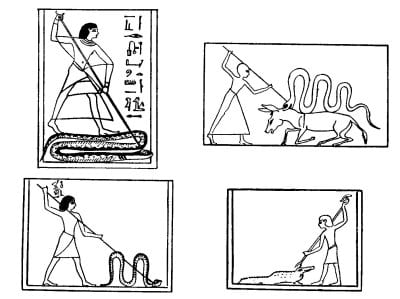
Compare the following scenes which represent Apep in the form of a serpent and crocodile and ass being pierced by the deceased.

蛇、鰐、ロバの姿のアペプが死者によって突き刺されるところを表した、次の諸場面と比較せよ。

Apep pierced by the deceased (Page 248)

【原本挿図】死者が槍で大蛇・ワニ・ロバの化身アペプを討伐する情景(p.248 注3)

注 [4]

The abtu and the ant fishes are sometimes depicted on coffins swimming at the bows of the boat of the sun.

アブトゥ魚とアント魚は、ときに棺の上に、太陽の舟の舳先で泳ぐ姿で描かれる。

📄原本ページ境界: {p. 249}(以上の本文および注釈がこのページに収められています)
第 5 ブロック📜 呪文本文 (Text)呪文本文:第15章(結願・至福の地への到達)

and Maat beside him; may I grasp the bows of the (17) seket[1] boat, and the stern of the atet boat. May he grant unto the ka of Osiris Ani to behold the disk of the Sun and to see the Moon-god without ceasing, every day; and may my soul (18) come forth and walk hither and thither and whithersoever it pleaseth. May my name be proclaimed when it is found upon the board of the table of (22) offerings; may offerings be made unto me in my (24) presence, even as they are made unto the followers of Horus; may there be prepared for me a seat in the boat of the Sun on the day of the going forth of the (26) god; and may I be received into the presence of Osiris in the land (28) of triumph!

マアトがその傍らにあるを、我に見せしめ給え。我をして (17) セケト[1]舟の舳先と、アテト舟の艫とを握らしめ給え。願わくは彼が、オシリス・アニのカーに、太陽の円盤を仰ぎ、月神を絶え間なく日ごとに見ることを許し給わんことを。また我が魂が (18) 出で来たりて、此方彼方、その欲するところへと歩み行かんことを。我が名が (22) 供物の卓の板の上に見出されるとき、宣べられんことを。ホルスの従者たちに供物が捧げられるごとく、我が (24) 面前にて我にも供物が捧げられんことを。神の出御の (26) 日に、太陽の舟の中に我がための座が設けられんことを。そして我が勝利の (28) 地にてオシリスの御前に迎え入れられんことを!

📝 このページの注釈・解説(1件)
注 [1]

A name of the boat of the rising sun.

昇る太陽の舟の名。

第 6 ブロック📎 付録・補遺 (Appendix)📖 底本 {p. 250}付録 I:ナヴィル版第14図(商人クエンナのパピルス 異文1)

Appendix: The following versions of this chapter are taken from: I. Naville, Todtenbuch, Bd. I., Pl. xiv. II. Naville, Todtenbuch, Bd. I., Pl. xv.; III. British Museum Papyrus No. 9901 and IV. British Museum Papyrus No. 10,471.

付録:本章の以下の諸版は、次のものから採った。I. ナヴィル『死者の書(Todtenbuch)』第1巻、図版xiv。II. ナヴィル『死者の書(Todtenbuch)』第1巻、図版xv。III. 大英博物館パピルス第9901号。IV. 大英博物館パピルス第10,471号。

I. (1) A HYMN OF PRAISE TO RA WHEN HE RISETH IN THE EASTERN PART OF HEAVEN. Behold Osiris, Qenna the merchant, (2) who saith: "Homage to thee, in thy rising thou Tmu in thy crowns of beauty. Thou risest, thou risest, thou Ra shinest, (3) thou shinest, at dawn of day. Thou art crowned like unto the king of the gods, and the goddess Shuti doeth homage unto thee. (4) The company of the gods praise thee from the double-dwelling. Thou goest forth over the upper air and thy heart is filled with gladness. (5) The sektet boat draweth onward as [Ra] cometh to the haven in the atet boat with fair winds. Ra rejoiceth, Ra rejoiceth. (6) Thy father is Nu, thy mother is Nut, and thou art crowned as Ra-Harmachis. Thy sacred boat advanceth in peace. Thy foe hath been cast down and his (7) head hath been cut off; the heart of the Lady of life rejoiceth in that the enemy of her lord hath been overthrown. The mariners of Ra have content of heart and Annu rejoiceth."

I. (1) 天の東方に昇るときのラーへの讃歌。見よ、商人オシリス・クエンナ、(2) 彼は言う:「汝に敬礼す、昇るにあたり麗しき冠を戴く汝アトゥムよ。汝は昇り、汝は昇る。汝ラーは輝き、(3) 汝は輝く、日の暁に。汝は神々の王のごとく冠を戴き、女神シュティは汝に敬礼す。(4) 神々の一団は二重の住まいより汝を讃う。汝は上空を越えて進み行き、汝の心は喜びに満つ。(5) 〔ラーが〕順風を受けてアテト舟にて港に来たるとき、セケト舟は進み行く。ラーは歓び、ラーは歓ぶ。(6) 汝の父はヌン、汝の母はヌト、汝はラー・ハルマキスとして冠を戴く。汝の聖なる舟は平安のうちに進む。汝の敵は投げ倒され、その (7) 首は切り落とされたり。生命の女主人の心は、その主の敵が打ち倒されたるゆえに歓ぶ。ラーの船乗りたちは心満ち足り、アンヌは歓ぶ。」

(8) The merchant Qenna saith: "I have come to thee, O Lord of the gods, Tmu-Harmachis, who passest over the earth . . . . . . . (9) I know that by which thou dost live. Grant that I may be like unto one of those who are thy favoured (10) ones [among the followers] of the great god. May my name be proclaimed, may it be found, may it be lastingly renewed with . . . . . . . (11) The oars are lifted into the sektet boat, and the sacred boat cometh in peace. (12) May I see Ra when he appeareth in the sky at dawn, and when his enemies have fallen at the block. (13) May I behold [Horus] guiding the rudder and steering with [his] two hands. (14) May I see the abtu fish at the moment of his creation; and may I see the ant fish when he maketh himself manifest at creation, and the ant boat upon its lake. O thou Only One, O thou Mighty One, thou Growing One, (15) who dost never wax faint, and from whom power cannot be taken. . . . . . . . . . . . . . the devoted (17) servant of \"the lord of Abtu.\""

(8) 商人クエンナは言う:「我は汝のもとに来たれり、おお神々の主、地を越えて過ぎ行くアトゥム・ハルマキスよ……(欠損)……(9) 我は、汝がそれによりて生くるところのものを知る。我をして、偉大なる神の〔従者たちのうち〕汝の寵を受くる (10) 者たちの一人のごとくならしめ給え。我が名が宣べられ、見出され、……(欠損)……とともに久しく新たにされんことを。(11) 櫂はセケト舟に揚げられ、聖なる舟は平安のうちに来たる。(12) 暁に天に現るるときのラーを、またその敵どもが断頭台に倒れたるときのラーを、我に見せしめ給え。(13) 〔ホルス〕が舵を導き、〔その〕両の手にて操るを、我に見せしめ給え。(14) アブトゥ魚をその創造の瞬間に、アント魚を創造においてその姿を現すときに、またアント舟をその湖の上に、我に見せしめ給え。おお唯一なる御方、おお力強き御方、おお成長する御方、(15) 決して衰えることなく、その力を奪われ得ぬ御方よ……(欠損)……「アブトゥの主」の忠実なる (17) 僕。」

"The merchant Qenna saith: (18) "Homage to thee Heru-Khuti-Tmu, Heru-Khepera, mighty hawk, who dost cause the body [of man] to make merry, beautiful of face by reason of thy two great plumes. Thou (19) wakest up in beauty at the dawn, when the company of the gods and mortals sing songs of joy unto thee; hymns of praise are offered unto thee at eventide. The (20) starry deities also adore thee. O thou firstborn, who dost lie without movement, (21) arise; thy mother showeth loving kindness unto thee every day. Ra liveth and the fiend Nak is dead; thou dost endure for ever, and the (22) fiend hath fallen.

商人クエンナは言う:(18)「汝に敬礼す、ヘル・クティ・アトゥム、ヘル・ケペラ、力強き鷹よ、〔人の〕体を楽しませ、その二つの大いなる羽飾りのゆえに顔麗しき御方よ。汝は (19) 暁に美しく目覚め、そのとき神々の一団と人間たちは汝に歓びの歌を歌い、夕べには汝に讃歌が捧げらる。(20) 星々の神々もまた汝を崇む。おお、動くことなく横たわる長子よ、(21) 起き上がれ。汝の母は日ごとに汝に慈しみを示す。ラーは生き、悪鬼ナクは死せり。汝は永遠に続き、(22) 悪鬼は倒れたり。

"Thou sailest over the sky with life and strength. The goddess Nehebka is in (23) the atet boat; the sacred boat rejoiceth. Thy heart is glad and thy brow is wreathed with the twin serpents."

「汝は生命と力とをもって天空を渡り行く。女神ネヘブカは (23) アテト舟の中にあり、聖なる舟は歓ぶ。汝の心は喜び、汝の額は二匹の蛇にて飾らる。」

📄原本ページ境界: {p. 250}(以上の本文および注釈がこのページに収められています)
第 7 ブロック📎 付録・補遺 (Appendix)📖 底本 {p. 251}付録 II:ナヴィル版第15図(商人クエンナのパピルス 異文2)

II. (1) A HYMN OF PRAISE TO RA WHEN HE RISETH IN THE EASTERN PART OF HEAVEN. Behold Osiris, Qenna the merchant, triumphant, who saith: (2) "Homage to thee, O thou who risest in Nu, and who at thy birth dost make the world bright with light; all the company of the gods (3) sing hymns of praise unto thee. The beings who minister unto Osiris cherish him as King of the North and of the South, the beautiful and beloved man-child. When (4) he riseth, mortals live. The nations rejoice in him, and the Spirits of Annu sing unto him songs of joy. The Spirits of the towns of Pe and Nekhen (5) exalt him, the apes of dawn adore him, and all beasts and cattle praise (6) him with one accord. The goddess Seba overthroweth thine enemies, therefore rejoice (7) within thy boat; and thy mariners are content thereat. Thou hast arrived in the atet boat, and thy heart swelleth with joy. O Lord of the gods, when thou (8) dost create them, they ascribe praises unto thee. The azure goddess Nut doth compass thee on every side, and the god Nu floodeth thee with his rays of light. (9) O cast thou thy light upon me and let me see thy beauties, me, the (10) Osiris Qenna the merchant, triumphant! When thou goest forth over the earth I will sing praises unto thy fair (11) face. Thou risest in the horizon of heaven, and [thy] disk is adored [when] it resteth upon the mountain to give life unto the world."

II. (1) 天の東方に昇るときのラーへの讃歌。見よ、義認されたる商人オシリス・クエンナ、彼は言う:(2)「汝に敬礼す、おお、ヌンより昇り、その誕生において世界を光にて輝かす御方よ。神々の一団はことごとく (3) 汝に讃歌を歌う。オシリスに仕える者たちは、南と北の王、麗しく愛さるる男児として彼を慈しむ。(4) 彼が昇るとき、人間は生く。諸国民は彼を歓び、アンヌの霊たちは彼に歓びの歌を歌う。ペとネケンの町々の霊たちは (5) 彼を崇め、暁のヒヒたちは彼を礼拝し、すべての獣と家畜は (6) 心を一つにして彼を讃う。女神セバは汝の敵どもを打ち倒す。ゆえに (7) 汝の舟の内にて歓べ。汝の船乗りたちはそれゆえに満ち足る。汝はアテト舟にて到着し、汝の心は歓びにふくらむ。おお神々の主よ、汝が (8) 彼らを創るとき、彼らは汝に讃美を帰す。碧き女神ヌトは四方より汝を囲み、ヌン神はその光線をもって汝を満たす。(9) おお、汝の光を我に注ぎ、汝の麗しさを我に見せしめ給え、我、(10) 義認されたる商人オシリス・クエンナに! 汝が地の上を進み行くとき、我は汝の麗しき (11) 御顔に讃美を歌わん。汝は天の地平に昇り、〔汝の〕円盤は、世界に生命を与えんと山の上に休らうとき、崇めらる。」

Saith Qenna the merchant, triumphant: (12) "Thou risest, thou risest, coming forth from the god Nu. Thou dost become young again and art the same as thou wert yesterday, O mighty youth who hast created thyself. Not . . . . . . . my hand. (13) Thou hast come with thy splendours, and thou hast made heaven and earth bright with thy rays of pure emerald light. The land of Punt is (14) established for the perfumes which thou smellest with thy nostrils. (15) Thou risest, O thou marvellous Being, in heaven, the twin serpents are placed upon thy brow, and thou art lord of the world and the inhabitants (16) thereof; [the company] of the gods and Qenna the merchant, triumphant, adore thee."

義認されたる商人クエンナは言う:(12)「汝は昇り、汝は昇る、ヌン神より出で来たりて。汝は再び若返り、昨日ありしと同じ汝にてあり、おお自らを創りし力強き若者よ。……ない……(欠損)……我が手。(13) 汝はその輝きとともに来たり、純なるエメラルドの光の光線をもって天と地を輝かせたり。プントの地は、(14) 汝がその鼻孔にて嗅ぐ香料のために定められたり。(15) 汝は昇る、おお驚くべき御方よ、天において。二匹の蛇は汝の額に置かれ、汝は世界とその (16) 住民の主なり。神々の〔一団〕と、義認されたる商人クエンナとは、汝を崇む。」

📄原本ページ境界: {p. 251}(以上の本文および注釈がこのページに収められています)
第 8 ブロック📎 付録・補遺 (Appendix)📖 底本 {p. 251}付録 III:大英博物館パピルス第9901号(宮廷長官フネフェルのパピルス)

III. (1, 2) A HYMN OF PRAISE TO RA WHEN HE RISETH IN THE EASTERN PART OF HEAVEN. (3) Behold Osiris Hunefer, triumphant, who saith: "Homage to thee, O thou who art Ra when thou (4) risest and Tmu when thou settest. Thou risest, thou risest; thou shinest, (5) thou shinest, thou who art crowned king of the gods. Thou art the lord of heaven, [thou art] the lord of earth, [thou art] the creator of those who dwell in the heights (6) and of those who dwell in the depths. [Thou art] the One god who came into (7) being in the beginning of time. Thou didst create the earth, (8) thou didst fashion man, thou didst make the watery abyss of the sky, thou didst form Hapi [the Nile], and thou art the maker of streams and of the (9) great deep, and thou givest life to all that is therein. Thou hast knit (10) together the mountains, thou has made mankind and the beasts of the field, thou hast created the heavens and the earth. Worshipped be thou whom the goddess Maat embraceth at morn and at eve. Thou dost travel across the (11) sky with heart swelling with joy; the Lake of Testes is at peace. The fiend Nak hath fallen and his two arms are cut off. The sektet boat receiveth fair winds, and the heart of him that is in his shrine rejoiceth. Thou (12) art crowned with a heavenly form, the Only one, provided [with all things]. Ra cometh forth from Nu in triumph. O thou mighty youth, thou everlasting son, self-begotten, who didst give thyself birth, (13) O thou mighty One, of myriad forms and aspects, king of the world, Prince of Annu, lord of eternity and ruler of the everlasting, the company of the gods rejoice when thou risest and when thou sailest (14) across the sky, O thou who art exalted in the sektet boat. Homage to thee, O Amen-Ra, thou who dost rest upon Maat, thou who passest over the heaven, and every face seeth thee. Thou dost wax great as thy (15) Majesty doth advance, and thy rays are upon all faces. Thou art unknown and canst not be searched out . . . . . . . . his fellow except thyself; thou art (16) the Only One . . . . . . [Men] praise thee in thy name [Ra], and they swear by thee, for thou art lord over them. Thou hast heard (17) with thine ears and thou hast seen with thine eyes. Millions of years have gone over the world; I cannot tell the number of them, through which thou hast passed. Thy heart hath decreed a day of happiness in thy name [of Ra]. Thou dost pass over (18) and travellest through untold spaces of millions and hundreds of thousands of years; thou settest out in peace, and thou steerest thy way across the watery abyss to the place which thou lovest; this thou doest in one (19) little moment of time, and thou dost sink down and makest an end of the hours."

III. (1, 2) 天の東方に昇るときのラーへの讃歌。(3) 見よ、義認されたるオシリス・フネフェル、彼は言う:「汝に敬礼す、おお、(4) 昇るときはラー、沈むときはアトゥムなる御方よ。汝は昇り、汝は昇る。汝は輝き、(5) 汝は輝く、神々の王として冠を戴く御方よ。汝は天の主、〔汝は〕地の主、〔汝は〕高きに住む者たちと (6) 深きに住む者たちの創造者なり。〔汝は〕時の始めに (7) 生じたる唯一の神なり。汝は大地を創り、(8) 人を形づくり、天の水の深淵を造り、ハピ〔ナイル〕を形づくり、流れと (9) 大いなる深淵とを造る者にして、その内にあるすべてのものに生命を与う。汝は (10) 山々を編み合わせ、人類と野の獣を造り、天と地を創りたり。女神マアトが朝に夕べに抱く汝は崇められよ。汝は歓びにふくらむ心をもって (11) 天空を渡り行く。テステスの湖は安らかなり。悪鬼ナクは倒れ、その両の腕は断ち切られたり。セケト舟は順風を受け、その祠の内にある者の心は歓ぶ。汝は (12) 天の姿をもって冠を戴き、〔すべてを〕備えたる唯一の御方なり。ラーは勝利のうちにヌンより出で来たる。おお力強き若者、永遠の子、自ら生まれ、自らに誕生を与えし御方よ、(13) おお幾万の姿と相とを持つ力強き御方、世界の王、アンヌの君、永遠の主にして永久の支配者よ、神々の一団は、汝が昇るとき、また汝が (14) 天空を航行するとき歓ぶ、おおセケト舟の内に高められたる御方よ。汝に敬礼す、おおアメン・ラーよ、マアトの上に安らい、天を渡り行き、あらゆる顔が見るところの御方よ。汝の (15) 威光が進むにつれて汝は大いなるものとなり、汝の光線はすべての顔の上にあり。汝は知られず、探り出され得ず……(欠損)……汝のほかにその同輩は〔なく〕、汝は (16) 唯一なる御方なり……(欠損)……〔人々は〕汝をその名〔ラー〕において讃え、汝にかけて誓う。汝は彼らの上に立つ主なればなり。汝は (17) その耳にて聞き、その目にて見たり。幾百万年が世の上を過ぎ去りたり。汝が通り過ぎたるその年の数を、我は語り得ず。汝の心は、汝の名〔ラーの名〕において幸いの日を定めたり。汝は、幾百万年、幾十万年の数知れぬ広がりを (18) 越え、旅し行く。汝は平安のうちに出立し、水の深淵を越えて、汝の愛する場所へと汝の道を舵取り行く。これを汝はひとつの (19) 小さき時の間に為し、沈み下りて時刻を終わらせる。」

Osiris, the governor of the palace of the lord of the two lands (i.e., Seti I.), Hunefer, triumphant, saith: (20) Hail my lord, thou that passest through eternity and whose being is everlasting. Hail thou Disk, lord of beams of light, thou risest and thou makest all mankind to live. Grant thou that I may behold thee at dawn each day."

二国の主(すなわちセティ1世)の宮殿の長官、義認されたるオシリス・フネフェルは言う:(20)「万歳、我が主よ、永遠を通り過ぎ、その存在の永久なる御方よ。万歳、円盤よ、光線の主よ、汝は昇りて全人類を生かす。日ごとに暁に汝を仰ぎ見ることを、我に許し給え。」

📄原本ページ境界: {p. 251}(以上の本文および注釈がこのページに収められています)
第 9 ブロック📎 付録・補遺 (Appendix)📖 底本 {p. 252} - {p. 253}付録 IV:大英博物館パピルス第10,471号(軍隊指揮官ネヒトのパピルス)

IV. A HYMN OF PRAISE TO RA by Nekht, the royal scribe, captain of soldiers, who saith: "Homage to thee, O thou glorious Being, thou who art provided [with all things]. O Tmu-Heru-khuti, when thou risest in the horizon of heaven, a cry of joy cometh out of the mouth of all peoples. O thou beautiful Being, thou dost renew thyself in thy season in the form of the Disk within thy mother Hathor; therefore in every place every heart swelleth with joy at thy rising, for ever. The eastern and the western parts of heaven come to thee with homage, and give forth sounds of joy at thy rising. O Ra, thou who art Heru-khuti (Harmachis), the mighty man-child, the heir of eternity, self-begotten and self-born, king of earth, prince of the netherworld, governor of the mountains of Aukert (i.e., the netherworld), thou dost rise in the horizon of heaven and sheddest upon the world beams of emerald light; thou art born from the water, thou art sprung from Nu, who fostereth thee and ordereth thy members. O thou who art crowned king of the gods, god of life, lord of love, all the nations live when thou dost shine. The goddess Nut doeth homage unto thee, and the goddess Maat embraceth thee at all times. They who are in thy following sing unto thee with joy and bow down to the earth when they meet thee, the god of heaven, the lord of earth, the king of right and truth, the god of eternity, the everlasting ruler, the prince of all the gods, the god of life, the creator of eternity, the maker of heaven by whom is established all that therein is. The company of the gods rejoice at thy rising, the earth is glad when it beholdeth thy rays; the peoples that have been long dead come forth with cries of joy to see thy beauties. Thou goest forth over heaven and earth, made strong each day by thy mother Nut. Thou passest through the uppermost heaven, thy heart swelleth with joy; and the Lake of Testes is content thereat. The Enemy hath fallen, his arms are hewn off, the knife hath cut asunder his joints. Ra liveth in Maa[1] the beautiful. The sektet boat draweth on and cometh into port; the south, the north, the west and the east turn to praise thee, O thou unformed substance of the earth, who didst create thyself. Isis and Nephthys salute thee, they sing unto thee in thy boat hymns of joy, they shield thee with their hands. The souls of the East follow thee, the souls of the West praise thee. Thou art the ruler of all gods and thou hast joy of heart within thy shrine; for the Serpent Nak is condemned to the fire, and thy heart shall be joyful for ever. Thy mother Nut is adjudged to thy father Nu."

IV. 王の書記、兵士らの隊長ネヒトによるラーへの讃歌。彼は言う:「汝に敬礼す、おお栄光ある御方、〔すべてを〕備えたる御方よ。おおアトゥム・ヘル・クティよ、汝が天の地平に昇るとき、歓びの叫びがあらゆる民の口より出づ。おお麗しき御方よ、汝はその季節に、汝の母ハトホルの内にて円盤の姿において自らを新たにす。ゆえにあらゆる所において、あらゆる心は汝の昇るに永遠に歓びにふくらむ。天の東の部分と西の部分とは敬礼をもって汝のもとに来たり、汝の昇るに歓びの声を発す。おおラーよ、ヘル・クティ(ハルマキス)なる御方、力強き男児、永遠の世継ぎ、自ら生まれ自ら生じたる者、地の王、冥界の君、アウケルト(すなわち冥界)の山々の支配者よ、汝は天の地平に昇り、世界の上にエメラルドの光の光線を注ぐ。汝は水より生まれ、汝を育み汝の肢体を整えるヌンより生じたり。おお神々の王として冠を戴く御方、生命の神、愛の主よ、汝が輝くとき、すべての国々は生く。女神ヌトは汝に敬礼し、女神マアトはあらゆる時に汝を抱く。汝の従者に連なる者たちは歓びをもって汝に歌い、汝に出会うとき地に伏し拝む——天の神、地の主、正義と真実の王、永遠の神、永久の支配者、すべての神々の君、生命の神、永遠の創造者、天の造り主にしてその内にあるすべてのものを定めたる御方なる汝に。神々の一団は汝の昇るを歓び、大地は汝の光線を見て喜ぶ。久しく死せる民らは、汝の麗しさを見んと歓びの叫びとともに出で来たる。汝は天と地を越えて進み行き、日ごとに汝の母ヌトによりて強められる。汝は最上の天を通り過ぎ、汝の心は歓びにふくらむ。テステスの湖はそれゆえに満ち足る。敵は倒れ、その腕は切り落とされ、刃はその関節を断ち切りたり。ラーは麗しきマア[1]の内に生く。セケト舟は進みて港に来たる。南も北も西も東も汝を讃えんと向き直る、おお自らを創りたる、形なき大地の実体よ。イシスとネフティスは汝に挨拶し、汝の舟の内にて汝に歓びの讃歌を歌い、その手をもって汝を護る。東の魂たちは汝に従い、西の魂たちは汝を讃う。汝はすべての神々の支配者にして、汝の祠の内にて心の歓びを持つ。蛇ナクは火に処せられ、汝の心は永遠に歓ばしからん。汝の母ヌトは汝の父ヌンに裁き与えられたり。」

📝 このページの注釈・解説(1件)
注 [1]

Maa, a name for Truth (i.e. Maat).

マア、真実(すなわちマアト)の名。

📄原本ページ境界: {p. 252} - {p. 253}(以上の本文および注釈がこのページに収められています)
← 前へ最初のページです目次へ戻る次へ →Plate II: 第2図:太陽円盤の礼拝と曙光の霊ヒヒ(ジェド柱とイシス・ネフティス)

他の図版へ移動:

Plate IPlate IIPlate IIIPlate IVPlates V & VIPlates VII-XPlates XI & XIIPlate XIIIPlate XIVPlate XVPlate XVIPlate XVIIPlate XVIIIPlate XIXPlate XXPlate XXIPlate XXIIPlates XXIII & XXIVPlate XXVPlate XXVIPlate XXVIIPlate XXVIIIPlates XXIX & XXXPlates XXXI & XXXIIPlate XXXII (cont.)Plate XXXIIIPlates XXXIII & XXXIVPlates XXXV & XXXVIPlate XXXVII

PR関連する本

  • 図説 エジプトの「死者の書」 (ふくろうの本) [ 村治笙子 ]楽天市場で見る
X でポストこのページを X で紹介できます

コメント

投稿はすぐ公開されます。投稿・評価の際に IP アドレスとブラウザの情報を記録し、ニックネームと識別用の ID を Cookie に保存します(詳しく)。0 / 1000

    まだコメントはありません。

    コメントを読み込んでいます…

    このコンテンツが登録されているカテゴリ

    • エンターテインメント › 占い、超常現象、都市伝説 ›スピリチュアル
    • エンターテインメント › 占い、超常現象、都市伝説 ›オカルト資料
    • 芸術と人文 › 文学 ›古典、詩歌
    • 芸術と人文 ›民俗・伝承
    • 芸術と人文 ›宗教・信仰
    • 芸術と人文 › 歴史、考古学 ›世界史

    アイコンから、そのカテゴリに登録された記事の新着を RSS リーダーで受け取れます

    INUUU JAPANについて-広告掲載-お問い合わせ

    RSSブログ・日記・夢日記の新着を、RSS リーダーで受け取れます

    Copyright © 2026 INUUU JAPAN. All rights reserved. 著作権について