INUUU JAPAN
トップ>芸術と人文>文学>古典、詩歌>エジプト死者の書>Plate III: 第3図:心臓の計量(真実の広間・最後の審判・第30章B)X でポスト
← 前へPlate II: 第2図:太陽円盤の礼拝と曙光の霊ヒヒ(ジェド柱とイシス・ネフティス)目次へ戻る次へ →Plate IV: 第4図:オシリスへの謁見(ホルスに導かれる義認されたアニ)
THE PAPYRUS OF ANI • PLATE III

第3図:心臓の計量(真実の広間・最後の審判・第30章B)

The Weighing of the Heart (The Hall of Truth) [Chapter XXXB]

本文 4 節完全日英対訳(E. A. Wallis Budge訳)大英博物館原本

古代エジプト死生観の核心。天秤の一方にアニの心臓(良心)、他方に真実の羽根(マアト)。アヌビスが秤を見守り、神聖なる怪獣アメミットが控え、トト神が結果をパピルスに記録する。

ひと目でわかる超要約『死者の書』最高の名場面の要点

古代エジプト死生観の核心。天秤の一方にアニの心臓(良心)、他方に真実の羽根(マアト)。アヌビスが秤を見守り、神聖なる怪獣アメミットが控え、トト神が結果をパピルスに記録する。

解説・位置づけこの図版(Plate)の背景と読みどころ

大英博物館『アニのパピルス』を世界的に有名にした「心臓の計量(最後の審判)」の図版です。上段には12柱の大神が陪審員として並び、中央ではジャッカル頭のアヌビス神が天秤の錘を調整し、死者の運命(シャイ)と誕生女神(レネネト・メスケネト)、人頭鳥身の魂(バー)が固唾をのんで見守ります。アニは自らの心臓に向かって「私に敵対して証言するな(第30章B)」と切実に祈り、トト神が「心臓はマアトの羽根と釣り合い、罪はない」と宣言することで怪獣アメミット(死者を喰らうもの)の脅威を免れます。

構成と各区分の要点(全4区分)

  1. 挿絵・情景解説(Vignette):挿絵・情景解説:死者の心臓の計量(真実の広間・十二柱の陪審神)第1ブロック ⤵

    挿絵:死者の心臓の計量の場面。アニとその妻が「二重の法すなわち真実の広間」に入る。そこでは、良心の象徴である心臓が、法の象徴である羽根と秤にかけられて量られることになっている。上方には、それ…

  2. 挿絵・情景解説(Vignette):挿絵・情景解説:天秤の調律と運命の神々(アヌビス・シャイ・メスケネト)第2ブロック ⤵

    神々の書記トトと結び付けられていた犬頭のヒヒが座している。ジャッカル頭の神アヌビスが秤の指針を調べており、秤を吊るす腕木は羽根の形をしている。アヌビスの頭上の銘文は次のとおりである——「墓の…

  3. 挿絵・情景解説(Vignette):挿絵・情景解説:書記トトと死者を呑み込む怪獣アメミット第3ブロック ⤵

    産室を司り、レネネトはおそらく子らの養育を監督する。メスケンの後ろには、塔門の上に立つ人頭の鳥の姿をしたアニの魂がいる。秤の右側、アヌビスの後ろには、神々の書記トトが、審理の結果を記録するた…

  4. 呪文本文(Text):呪文本文:第30章B(心臓への祈願・トト神の義認・神々の無罪判決)第4ブロック ⤵

    本文:〔第30章B〕書記オシリス・アニは言う:「我が心臓、我が母よ、我が心臓、我が母よ、我が心臓、我が生成よ! 〔我が〕裁きにおいて我に抗うものなからんことを。チャチャより我への反対なからん…

重要語句・基本概念

第30章B(心臓の呪文)
審判の天秤の上で、自分の心臓(良心・記憶)が自分を裏切って不利な証言をしないよう懇願する最重要の呪文。黄金のスカラベにも刻まれた。
アメミット(Am-mit / 死者を喰らうもの)
ワニの頭、ライオンの前半身、カバの後半身をもつ審判の怪獣。天秤で罪ありとされた心臓をその場で喰らい、永遠の消滅(二度目の死)をもたらす。
表示:
第 1 ブロック🎨 挿絵・情景解説 (Vignette)📖 底本 {p. 256}挿絵・情景解説:死者の心臓の計量(真実の広間・十二柱の陪審神)

Vignette: Scene of the weighing of the Heart of the Dead. Ani and his wife enter the Hall of Double Law or Truth, wherein the heart, emblematical of the conscience, is to be weighed in the balance against the feather, emblematical of law. Above, twelve gods, each holding a sceptre are seated upon thrones before a table of offerings of fruit, flowers, etc. Their names are: Harmachis, "the great god within his boat"; Tmu; Shu; Tefnut, "lady of heaven"; Seb; Nut, "lady of Heaven"; Isis; Nephthys; Horus, "the great god"; Hathor, "lady of Amenta"; and Sa. Upon the beam of the scales sits the dog-headed ape which was associated

挿絵:死者の心臓の計量の場面。アニとその妻が「二重の法すなわち真実の広間」に入る。そこでは、良心の象徴である心臓が、法の象徴である羽根と秤にかけられて量られることになっている。上方には、それぞれ王笏を持つ十二柱の神々が、果物、花などの供物台の前で玉座に座している。その名は、ハルマキス「その舟の内なる大いなる神」、アトゥム、シュー、テフヌト「天の女主人」、セブ、ヌト「天の女主人」、イシス、ネフティス、ホルス「大いなる神」、ハトホル「アメンタの女主人」、そしてサである。秤の竿の上には、

📝 このページの注釈・解説(1件)
注 [1]

In British Museum papyrus No. 9901 the goddess Maat is seated on the centre of the beam of the balance. The double Maat goddesses are at times represented standing beside the balance to watch the result of the weighing, and at the same time Maat is also placed in the scale to be weighed against the heart of the deceased (Fig. 1) (see Naville, Todtenbuch, Bd. I., Bl. 136, Pa.). In the papyrus of Qenna the head of Anubis is on the beam, and the ape, wearing disk and crescent, is seated upon a pylon-shaped pedestal beside the balance (Fig. 2). Another vignette shows Horus holding Maat in his hand, weighing the heart in the presence of the Maat goddesses, and Anubis, holding the deceased by the hand, presents the heart to Osiris while Isis and Nephthys in the form of apes sit near (Fig. 3).

大英博物館パピルス第9901号では、女神マアトが秤の竿の中央に座している。二重のマアト女神は、ときに計量の結果を見守るために秤の傍らに立つ姿で表され、同時にマアトは、死者の心臓と量られるために秤皿にも置かれる(図1)(ナヴィル『死者の書(Todtenbuch)』第1巻、図版136、Pa を参照)。クエンナのパピルスでは、竿の上にアヌビスの頭があり、円盤と三日月を戴いたヒヒが秤の傍らの塔門形の台座に座している(図2)。別の挿絵では、ホルスがマアトを手に持ってマアト女神たちの前で心臓を量り、アヌビスが死者の手を取って心臓をオシリスに差し出し、その間イシスとネフティスがヒヒの姿で近くに座している(図3)。
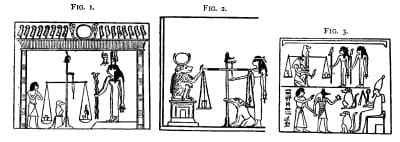
大英博物館パピルス第9901号およびクエンナ版の計量図スケッチ

【学術挿図(Fig. 1-3)】他パピルスにおける天秤の上のマアト女神とヒヒ神・アヌビスの異文スケッチ(原本p.256)
📄原本ページ境界: {p. 256}(以上の本文および注釈がこのページに収められています)
第 2 ブロック🎨 挿絵・情景解説 (Vignette)📖 底本 {p. 257}挿絵・情景解説:天秤の調律と運命の神々(アヌビス・シャイ・メスケネト)

with Thoth,[1] the scribe of the gods. The god Anubis, jackal-headed, tests the tongue of the balance, the suspending bracket of which is in the form of the feather. The inscription above the head of Anubis reads:--"He who is in the tomb saith, 'I pray thee, O weigher of righteousness, to guide (?) the balance that it may be stablished.'" On the left of the balance, facing Anubis, stands Ani's "Luck" or "Destiny," Shai; and above is the object called mesxen which has been described[2] as "a cubit with human head," and which is supposed to be connected with the place of birth. Behind these stand the goddesses Meskhenet and Renenet: Meskhenet[3]

神々の書記トト[1]と結び付けられていた犬頭のヒヒが座している。ジャッカル頭の神アヌビスが秤の指針を調べており、秤を吊るす腕木は羽根の形をしている。アヌビスの頭上の銘文は次のとおりである——「墓の内にある者は言う、『おお正義を量る者よ、秤が定まるよう、これを導き(?)給えと、我は汝に祈る。』」秤の左側、アヌビスに向かい合って、アニの「幸運」すなわち「運命」であるシャイが立つ。その上方には、メスケンと呼ばれる物があり、これは「人の頭の付いたキュビット尺」と記述され[2]、誕生の場所と関係があると考えられている。これらの後ろには女神メスケネトとレネネトが立つ。メスケネト[3]は

📝 このページの注釈・解説(3件)
注 [1]

In the papyrus of Sutimes (Naville, Todtenbuch, Bd. I., Bl. 43) the ape is called neb xemennu ut a maa, "Lord of Khemennu, just weigher"; and in British Museum papyrus No. 9900, "Thoth, lord of the scales."

ステメスのパピルス(ナヴィル『死者の書(Todtenbuch)』第1巻、図版43)では、このヒヒは neb xemennu ut a maa、「ケメンヌの主、正しく量る者」と呼ばれ、大英博物館パピルス第9900号では「トト、秤の主」と呼ばれる。

注 [2]

Birch, in Bunsen's Egypt's Place, vol. v., p. 259. In the papyrus of Anhai (British Museum, No. 10,472) there is a meskhen on each side of the upright of the balance: one is called Shai and the other Renen.

バーチ、ブンゼン『世界史におけるエジプトの位置(Egypt's Place)』第5巻、259頁。アンハイのパピルス(大英博物館第10,472号)では、秤の支柱の両側にメスケンが一つずつあり、一方はシャイ、他方はレネンと呼ばれている。

注 [3]

Four goddesses bore the name of Meskhen, and they were supposed to assist the resurrection of Osiris; they were associated with Tefnut, Nut, Isis, and Nephthys. Each wore upon her head the object which is said by some to represent the blossoms of palm trees.

四柱の女神がメスケンの名を持ち、オシリスの復活を助けると考えられていた。彼女たちはテフヌト、ヌト、イシス、ネフティスと結び付けられていた。それぞれ頭上に、ある人々によれば棕櫚の木の花を表すとされる物を戴いていた。

📄原本ページ境界: {p. 257}(以上の本文および注釈がこのページに収められています)
第 3 ブロック🎨 挿絵・情景解説 (Vignette)📖 底本 {p. 258}挿絵・情景解説:書記トトと死者を呑み込む怪獣アメミット

presiding over the birth-chamber, and Renenet[1] probably superintending the rearing of children. Behind the meskhen is the soul of Ani in the form of a human-headed bird standing on a pylon. On the right of the balance, behind Anubis, stands Thoth,[2] the scribe of the gods, with his reed-pen and palette[3] containing black and red ink, with which to record the result of the trial. Behind Thoth stands the female monster Amam[4], the "Devourer," or Am-mit, the eater of the Dead."

産室を司り、レネネト[1]はおそらく子らの養育を監督する。メスケンの後ろには、塔門の上に立つ人頭の鳥の姿をしたアニの魂がいる。秤の右側、アヌビスの後ろには、神々の書記トト[2]が、審理の結果を記録するための葦ペンと、黒と赤のインクを入れたパレット[3]とを持って立つ。トトの後ろには、雌の怪物アマム[4]、「貪る者」、すなわち死者を食らうアム・ミトが立つ。

📝 このページの注釈・解説(4件)
注 [1]

The name of this goddess is probably connected with the word renen, "to suckle." M. Pierret identifies her with the goddess of that name who presided over harvests, and is described as the "lady of the offerings of all the gods", having a snake's head.

この女神の名は、おそらく「乳を飲ませる」を意味する語 renen と関係がある。ピエレ氏は彼女を、収穫を司った同名の女神と同一視している。その女神は「すべての神々の供物の女主人」と記述され、蛇の頭を持つ。

注 [2]

Thoth was the personification of intelligence. He was self-created and self-existent, and was the "heart of Ra." He invented writing, letters, the arts and sciences, and he was skilled in astronomy and mathematics. Among his many titles are "lord of Law," "maker of Law," and "begetter of Law." He justified Osiris against his enemies...

トトは知性の擬人化であった。彼は自ら創られ、自ら存在する者であり、「ラーの心臓」であった。彼は書記法、文字、技芸と諸学を発明し、天文学と数学に通じていた。その多くの称号の中には「法の主」「法を作る者」「法を生む者」がある。彼はオシリスを、その敵たちに対して義としたのであった……

注 [3]

The palettes of the Egyptian scribe were rectangular, and were made of wood, stone, basalt, ivory. They measure from 10 to 17 inches in length, and from 2 to 3 inches in width. They usually contain two round cavities to hold red and black ink, and a groove to hold the reed-pens.

エジプトの書記のパレットは長方形で、木、石、玄武岩、象牙で作られていた。長さは10インチから17インチ、幅は2インチから3インチである。通常、赤と黒のインクを入れる二つの丸い窪みと、葦ペンを入れる溝とがある。

注 [4]

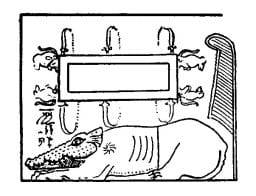
She is also called "Devourer of Amenta" (i.e., the underworld), and Shai. In the British Museum papyrus No. 9901 she is described as: "the fore-part of a crocodile; her hind-quarters are those of a hippopotamus; her middle part [is that] of a lion." The Devourer usually stands near the balance instead of behind Thoth; but there is one papyrus quoted by Naville, in which she is shown crouching beside the lake of fire in the infernal regions.

彼女はまた「アメンタ(すなわち冥界)を貪る者」とも、シャイとも呼ばれる。大英博物館パピルス第9901号では、彼女は次のように記述されている。「前部は鰐、後部は河馬、中部は獅子〔のそれ〕である。」貪る者は通常、トトの後ろではなく秤の近くに立つ。しかしナヴィルが引用する一つのパピルスでは、彼女は冥界の火の湖の傍らにうずくまる姿で示されている。

怪獣アメミット(ワニ・ライオン・カバの合成獣)の原本スケッチ

【学術挿図(Fig. 4)】死者を呑み込む怪獣アメミット(Am-mit the Devourer)の姿(原本p.258)

📄原本ページ境界: {p. 258}(以上の本文および注釈がこのページに収められています)
第 4 ブロック📜 呪文本文 (Text)📖 底本 {p. 259}呪文本文:第30章B(心臓への祈願・トト神の義認・神々の無罪判決)

Text: [Chapter XXXB.] Osiris, the scribe Ani, saith:[1] "My heart my mother, my heart my mother, my heart my coming into being! May there be nothing to resist me at [my] judgment; may there be no opposition to me from the Tchatcha;[2] may there be no parting of thee from me in the presence of him who keepeth the scales! Thou art my ka within my body [which] knitteth[3] and strengtheneth my limbs. Mayest thou come forth to the place of happiness to which[4] I am advancing. May the Shenit[5] not cause my name to stink, and may no lies be spoken against me in the presence of the god![6] Good is it for thee to hear."[7]

本文:〔第30章B〕書記オシリス・アニは言う[1]:「我が心臓、我が母よ、我が心臓、我が母よ、我が心臓、我が生成よ! 〔我が〕裁きにおいて我に抗うものなからんことを。チャチャ[2]より我への反対なからんことを。秤を守る者の御前にて、汝が我より離れることなからんことを! 汝は我が体の内なる我がカーにして、我が四肢を編み合わせ[3]、強めるものなり。我が進み行く[4]幸いの場所へ、汝も出で来たらんことを。シェニト[5]が我が名を臭わしめることなく、神[6]の御前にて我に対して偽りが語られることなからんことを! 汝が聞くは善きことなり。」[7]

Thoth, the righteous judge of the great company of the gods who are in the presence of the god Osiris, saith: "Hear ye this judgment. The heart of Osiris hath in very truth been weighed, and his soul hath stood as a witness for him; it hath been found true by trial in the Great Balance. There hath not been found any wickedness in him; he hath not wasted the offerings in the temples; he hath not done harm by his deeds; and he uttered no evil reports while he was upon earth."

オシリス神の御前にある神々の大いなる一団の正しき裁き手トトは言う:「この裁きを聞け。オシリスの心臓はまことに量られ、その魂は彼のための証人として立ちたり。それは大いなる秤における審理によって真実と認められたり。彼の内には何の邪悪も見出されず、彼は神殿の供物を浪費せず、その行いによって害をなさず、地上にありし間、悪しき噂を口にすることもなかりき。」

The great company of the gods reply to Thoth dwelling in Khemennu: "That which cometh forth from thy mouth hath been ordained. Osiris, the scribe Ani, triumphant, is holy and righteous. He hath not sinned, neither hath he done evil against us. Let it not be given to the devourer Amemet to prevail over him. Meat-offerings and entrance into the presence of the god Osiris shall be granted unto him, together with a homestead for ever in Sekhet-hetepu, as unto the followers of Horus."

神々の大いなる一団は、ケメンヌに住むトトに答える:「汝の口より出づるものは定められたり。義認されたる書記オシリス・アニは、聖にして正しき者なり。彼は罪を犯さず、我らに対して悪を為すこともなかりき。貪る者アメメトが彼に打ち勝つことを許すなかれ。肉の供物と、オシリス神の御前への入場とが、ホルスの従者たちに対するがごとく、セケト・ヘテプにおける永遠の領地とともに、彼に与えられるべし。」

📝 このページの注釈・解説(7件)
注 [1]

Ani's speech forms the text of Chapter XXXB. as numbered by M. Naville (Todtenbuch, Bd. I., Bl. 43).

アニの言葉は、ナヴィル氏の番号付け(『死者の書(Todtenbuch)』第1巻、図版43)による第30章Bの本文を成す。

注 [2]

The four gods of the cardinal points, Mestha, Hapi, Tuamautef, and Qebhsennuf (see Naville, Todtenbuch Einleitung, p. 164).

四方位の四柱の神々、メスタ、ハピ、トゥアムテフ、ケブセンヌフ(ナヴィル『死者の書 序説(Todtenbuch Einleitung)』164頁を参照)。

注 [3]

Some copies read, "Thou art my ka within my body, the god Khnemu (i.e., "Moulder"), who uniteth (or formeth) and strengtheneth my limbs."

写本によっては、「汝は我が体の内なる我がカー、我が四肢を結び合わせ(あるいは形づくり)、強める神クヌム(すなわち「形づくる者」)なり」と読む。

注 [4]

British Museum papyrus No. 9901 has "place of happiness to which thou goest with me."

大英博物館パピルス第9901号では「汝が我とともに行く幸いの場所」とある。

注 [5]

A class of divine beings.

神的存在の一階級。

注 [6]

I.e., "the great god, lord of Amenta."

すなわち「大いなる神、アメンタの主」。

注 [7]

This sentence appears to be unfinished; see the Egyptian text, p. 12.

この文は未完のように見える。エジプト語本文、12頁を参照。

📄原本ページ境界: {p. 259}(以上の本文および注釈がこのページに収められています)
← 前へPlate II: 第2図:太陽円盤の礼拝と曙光の霊ヒヒ(ジェド柱とイシス・ネフティス)目次へ戻る次へ →Plate IV: 第4図:オシリスへの謁見(ホルスに導かれる義認されたアニ)

他の図版へ移動:

Plate IPlate IIPlate IIIPlate IVPlates V & VIPlates VII-XPlates XI & XIIPlate XIIIPlate XIVPlate XVPlate XVIPlate XVIIPlate XVIIIPlate XIXPlate XXPlate XXIPlate XXIIPlates XXIII & XXIVPlate XXVPlate XXVIPlate XXVIIPlate XXVIIIPlates XXIX & XXXPlates XXXI & XXXIIPlate XXXII (cont.)Plate XXXIIIPlates XXXIII & XXXIVPlates XXXV & XXXVIPlate XXXVII

PR関連する本

  • 図説 エジプトの「死者の書」 (ふくろうの本) [ 村治笙子 ]楽天市場で見る
X でポストこのページを X で紹介できます

コメント

投稿はすぐ公開されます。投稿・評価の際に IP アドレスとブラウザの情報を記録し、ニックネームと識別用の ID を Cookie に保存します(詳しく)。0 / 1000

    まだコメントはありません。

    コメントを読み込んでいます…

    このコンテンツが登録されているカテゴリ

    • エンターテインメント › 占い、超常現象、都市伝説 ›スピリチュアル
    • エンターテインメント › 占い、超常現象、都市伝説 ›オカルト資料
    • 芸術と人文 › 文学 ›古典、詩歌
    • 芸術と人文 ›民俗・伝承
    • 芸術と人文 ›宗教・信仰
    • 芸術と人文 › 歴史、考古学 ›世界史

    アイコンから、そのカテゴリに登録された記事の新着を RSS リーダーで受け取れます

    INUUU JAPANについて-広告掲載-お問い合わせ

    RSSブログ・日記・夢日記の新着を、RSS リーダーで受け取れます

    Copyright © 2026 INUUU JAPAN. All rights reserved. 著作権について