
INUUU JAPAN
トップ>芸術と人文>文学>古典、詩歌>エジプト死者の書>Plate II: 第2図:太陽円盤の礼拝と曙光の霊ヒヒ(ジェド柱とイシス・ネフティス)X でポスト
← 前へPlate I: 第1図:太陽神ラーへの賛歌(日出づる時の讃美・第15章)目次へ戻る次へ →Plate III: 第3図:心臓の計量(真実の広間・最後の審判・第30章B)
THE PAPYRUS OF ANI • PLATE II

第2図:太陽円盤の礼拝と曙光の霊ヒヒ(ジェド柱とイシス・ネフティス)

Adoration of the Solar Disk and the Spirits of Dawn

本文 4 節完全日英対訳(E. A. Wallis Budge訳)大英博物館原本

オシリスの象徴ジェド柱と生命のアンクが支える太陽円盤。その両脇で手を掲げて礼拝する暁の聖なるヒヒたち、そしてイシスとネフティス両女神の姿。

ひと目でわかる超要約この章・文書の要点

オシリスの象徴ジェド柱と生命のアンクが支える太陽円盤。その両脇で手を掲げて礼拝する暁の聖なるヒヒたち、そしてイシスとネフティス両女神の姿。

解説・位置づけこの図版(Plate)の背景と読みどころ

第1図に続く太陽礼拝の図像(ヴィネット)と呪文です。安定と復活を表すジェド柱から生えた腕が太陽円盤を天へ押し上げ、イシス・ネフティス両女神と夜明けの精霊であるヒヒたちが、昇る太陽に歓喜の賛歌を捧げます。

構成と各区分の要点(全4区分)

  1. 挿絵・情景解説(Vignette):挿絵・情景解説:太陽円盤の礼拝と曙光の霊ヒヒ(ジェド柱とイシス・ネフティス)第1ブロック ⤵

    挿絵 I:太陽の円盤が、生命のしるしアンクから出た一対の腕によって支えられ、そのアンクはさらに、東方およびオシリス神の象徴であるテト(ジェド柱)によって支えられている。テトは地平の上に立つ。…

  2. 呪文本文(Text):呪文本文:冥界の主オシリスへの賛歌(永遠の支配者・オシリス・ウンネフェル)第2ブロック ⤵

    本文:(1)〔オシリスへの讃歌〕「アビュドスの内にまします大いなる神、永遠の王、とこしえの主、その存在において幾百万年を過ぎ行くオシリス・ウンネフェルに栄光あれ。ヌトの (2) 胎の長子、エ…

  3. 呪文本文(Text):呪文本文:神々の礼拝とオシリスの尊称(万物の主ネブ・エル・チェル)第3ブロック ⤵

    アメンタの山にある汝の心が満ち足らんことを。汝の子ホルスは汝の玉座に堅く据えられたればなり。(4) 汝はタットゥの主として冠を戴き、アブトゥにて統べる者なり。汝によりて世界は (5) ネブ・…

  4. 呪文本文(Text):呪文本文:第15章結願(冥界の旅と楽園セケト・アルでの永遠の生命)第4ブロック ⤵

    タ・セルトにて顔麗しき御方よ。オシリスなる書記アニのカーに、天における輝きと地における力と、ネテル・ケルトにおける勝利とを与え給え。また我が、生ける魂のごとく (11) タットゥへと下り、ベ…

重要語句・基本概念

ジェド柱(Tet / Djed)とアンク(Ankh)
オシリス神の背骨を象徴し「永続・安定・復活」をもたらすジェド柱と、「永遠の生命」を表す十字形の護符アンク。
表示:
第 1 ブロック🎨 挿絵・情景解説 (Vignette)📖 底本 {p. 253}挿絵・情景解説:太陽円盤の礼拝と曙光の霊ヒヒ(ジェド柱とイシス・ネフティス)

Vignette I.: The disk of the Sun, supported by a pair of arms proceeding from the ankh, the sign of life, which in turn is supported by a tet the emblem of the East and of the god Osiris. The tet stands upon the horizon. On each side of the disk are three dog-headed apes, spirits of the Dawn, their arms raised in adoration of the disk. On the right hand side of the tet is the goddess Nephthys and on the left is Isis each goddess raising her hands in adoration of the tet, and kneeling upon the emblem aat, or hemisphere. Above is the sky. This vignette belongs properly to the hymn to the rising sun.[2]

挿絵 I:太陽の円盤が、生命のしるしアンクから出た一対の腕によって支えられ、そのアンクはさらに、東方およびオシリス神の象徴であるテト(ジェド柱)によって支えられている。テトは地平の上に立つ。円盤の両側には、暁の霊である犬頭のヒヒが三頭ずつおり、円盤を崇めて両腕を挙げている。テトの右側には女神ネフティス、左側にはイシスがおり、どちらの女神もテトを崇めて両手を挙げ、アアトすなわち半球の標識の上に跪いている。上方は天である。この挿絵は、本来は昇る太陽への讃歌に属するものである[2]。

📝 このページの注釈・解説(2件)
注 [1]

Maa, unvarying and unalterable Law. Compare the vignette from British Museum papyrus No. 9901. (Fig. 1.)

マア、変わることなく改めえぬ法。大英博物館パピルス第9901号の挿絵(図1)と比較せよ。
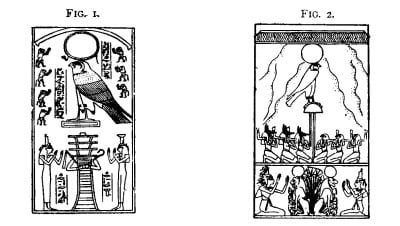
大英博物館パピルス第9901号の挿図(太陽円盤とヒヒ)

【学術挿図(Fig. 1)】大英博物館パピルス第9901号における太陽円盤と曙光の霊ヒヒの礼拝図(原本p.253)

注 [2]

In some papyri the apes are four (Naville, Das Aeg. Todtenbuch, Bd. I., Bl. 26), or seven (Naville, op. cit., Bd. I., Bl. 21) in number. In the vignette which usually accompanies the hymn to the setting sun (Fig. 2), but which does not occur in the present papyrus, a hawk wearing on his head a disk encircled by a serpent, i.e., Ra-Harmachis, takes the place of the disk and (e.g., British Museum papyri Nos. 9901 and 10,472); and the tet is represented by the stand (Naville, op. cit., Bd. I., Bl. 22), on one side of which are three hawk-headed deities, and on the other three jackal-headed deities (see Lanzone, Dizionario, pp. 56, 57). Beneath are Isis and Nephthys kneeling in adoration before two lion-gods, which represent yesterday and to-morrow. An interesting variant of the latter vignette occurs in British Museum papyrus No. 10,472, which was made for the lady Anhai, a singer in the temple of Amen at Thebes, about B.C. 1000...

パピルスによっては、ヒヒは四頭(ナヴィル『エジプト死者の書(Das Aeg. Todtenbuch)』第1巻、図版26)、あるいは七頭(ナヴィル前掲書、第1巻、図版21)である。沈む太陽への讃歌に通常添えられる挿絵(図2)——ただし本パピルスには現れない——では、頭上に蛇に囲まれた円盤を戴く鷹、すなわちラー・ハルマキスが円盤およびアンクの位置を占め(例えば大英博物館パピルス第9901号および第10,472号)、テトは台によって表される(ナヴィル前掲書、第1巻、図版22)。その台の片側には鷹頭の神々が三柱、もう片側にはジャッカル頭の神々が三柱いる(ランツォーネ『辞典(Dizionario)』56、57頁を参照)。その下では、イシスとネフティスが、昨日と明日を表す二柱の獅子神の前に跪いて崇めている。後者の挿絵の興味深い異形が、大英博物館パピルス第10,472号に見られる。これは紀元前1000年頃、テーベのアメン神殿の歌い手であった婦人アンハイのために作られたものである……
📄原本ページ境界: {p. 253}(以上の本文および注釈がこのページに収められています)
第 2 ブロック📜 呪文本文 (Text)📖 底本 {p. 254}呪文本文:冥界の主オシリスへの賛歌(永遠の支配者・オシリス・ウンネフェル)

Text: (1) [HYMN TO OSIRIS.] "Glory be to Osiris Un-nefer, the great god within Abydos, king of eternity, lord of the everlasting, who passeth through millions of years in his existence. Eldest son of the womb (2) of Nut, engendered by Seb the Erpat,[1] lord of the crowns of the North and South, lord of the lofty white crown. As Prince of gods and of men (3) he hath received the crook and the flail and the dignity of his divine fathers.[2] Let thy heart which is

本文:(1)〔オシリスへの讃歌〕「アビュドスの内にまします大いなる神、永遠の王、とこしえの主、その存在において幾百万年を過ぎ行くオシリス・ウンネフェルに栄光あれ。ヌトの (2) 胎の長子、エルパト[1]なるセブに生まれし者、北と南の冠の主、高き白冠の主よ。神々と人間の君として、(3) 彼は牧杖と殻竿と、その神なる父祖たちの位[2]とを受けたり。願わくは、

📝 このページの注釈・解説(2件)
注 [1]

The word er-pat is composed of er "chief" and pat a clan, "tribe," or "family"; Seb, then, was the prince of the family of the gods. Erpat is a very ancient word, and was probably in use in Egypt before suten, the common word for "king." For a discussion on this point see Maspero, Un Manuel de Hiérarchie Égyptienne, p. 15 ff.; Brugsch, Aegyptologie, p. 210.

エル・パト(er-pat)という語は、「長」を意味する er と、氏族、「部族」あるいは「家族」を意味する pat とから成る。すなわちセブは神々の家族の君であった。エルパトは非常に古い語であり、「王」を表す普通の語スーテン(suten)より前からエジプトで用いられていたと思われる。この点に関する議論については、マスペロ『エジプトの位階の手引き(Un Manuel de Hiérarchie Égyptienne)』15頁以下、ブルクシュ『エジプト学(Aegyptologie)』210頁を参照。

注 [2]

Osiris, the night sun, was the son of Ra, and the father and son of Horus. He is always represented as a mummy holding in his hands the sceptre crook and flail. See Lanzone, Dizionario, p. 690 ff.; Wiedemann, Religion, p. 123 ff.; Brugsch, Religion und Mythologie, p. 611 ff.

夜の太陽オシリスはラーの子であり、ホルスの父にして子であった。彼は常に、手に王笏である牧杖と殻竿とを持つミイラとして表される。ランツォーネ『辞典(Dizionario)』690頁以下、ヴィーデマン『宗教(Religion)』123頁以下、ブルクシュ『宗教と神話(Religion und Mythologie)』611頁以下を参照。

📄原本ページ境界: {p. 254}(以上の本文および注釈がこのページに収められています)
第 3 ブロック📜 呪文本文 (Text)📖 底本 {p. 255}呪文本文:神々の礼拝とオシリスの尊称(万物の主ネブ・エル・チェル)

in the mountain of Amenta be content, for thy son Horus is stablished upon thy throne. (4) Thou art crowned lord of Tattu[1] and ruler in Abtu.[2] Through thee the world waxeth green (5) in triumph before the might of Neb-er-tcher.[3] He leadeth in his train that which is and that which is not yet, in his name (6) Ta-her-seta-nef;[4] he toweth along the earth in triumph in his name Seker.[5] He is (7) exceeding mighty and most terrible in his name Osiris. He endureth for ever and for ever in his name Un-nefer.[6] (8) Homage to thee, King of kings, Lord of lords, Prince of princes, who from the womb of Nut hast possessed the world (9) and hast ruled all lands and Akert.[7] Thy body is of gold, thy head is of azure, and emerald light encircleth thee. O An[8] of millions of years, (10) all-pervading with thy body and

アメンタの山にある汝の心が満ち足らんことを。汝の子ホルスは汝の玉座に堅く据えられたればなり。(4) 汝はタットゥ[1]の主として冠を戴き、アブトゥ[2]にて統べる者なり。汝によりて世界は (5) ネブ・エル・チェル[3]の威力の前に勝利のうちに緑に萌え出づ。彼は、その名 (6) タ・ヘル・セタ・ネフ[4]において、現にあるものと未だあらざるものとをその列に率い、その名セケル[5]において勝利のうちに大地を曳き行く。彼は (7) その名オシリスにおいてこの上なく力強く、最も恐るべき者なり。彼はその名ウンネフェル[6]において永遠に、とこしえに続く。(8) 汝に敬礼す、王の中の王、主の中の主、君の中の君よ、ヌトの胎より世界を領し (9)、すべての地とアケルト[7]とを統べたる御方よ。汝の体は黄金、汝の頭は紺碧、エメラルドの光が汝を取り巻く。おお幾百万年のアン[8]よ、(10) その体をもってあまねく満ち、

📝 このページの注釈・解説(9件)
注 [1]

The name Tettet or Tattu was borne by two towns in Lower Egypt: Busiris, the metropolis of the 9th nome, and Mendes, the metropolis of the 16th nome. See Brugsch, Dict. Géog., p. 978, and De Rougé, Géographie Ancienne de la Basse Égypte, p. 58.

テッテトあるいはタットゥという名は、下エジプトの二つの町が持っていた。第9ノモスの首府ブシリスと、第16ノモスの首府メンデスである。ブルクシュ『地名辞典(Dict. Géog.)』978頁、およびド・ルージェ『下エジプト古代地理(Géographie Ancienne de la Basse Égypte)』58頁を参照。

注 [2]

Both Busiris and Abydos claimed to be the resting place of the body of Osiris.

ブシリスとアビュドスの双方が、オシリスの体の安置所であると主張した。

注 [3]

A name of Osiris when his scattered limbs had been brought together and built up again into a body by Isis and Nephthys: see Lanzone, Dizionario, p. 714. The name means "lord of entirety."

散らばった四肢がイシスとネフティスによって集められ、再び体に組み上げられたときのオシリスの名。ランツォーネ『辞典(Dizionario)』714頁を参照。この名は「全体の主」を意味する。

注 [4]

I.e., The one who draws the world.

すなわち、世界を曳く者。

注 [5]

Seker is, like Ptah, Osiris, and Tenen, a form of the night sun. At the festival of this god, the Hennu boat, a symbol of the god Seker of Memphis, was drawn round the sanctuary at dawn at the moment when the sun casts its golden rays upon the earth. For a list of Seker's shrines, see Lanzone, Dizionario, pp. 1117-1119.

セケルは、プタハ、オシリス、テネンと同じく、夜の太陽の一形態である。この神の祭りでは、メンフィスのセケル神の象徴であるヘンヌ舟が、太陽が大地にその黄金の光線を投げかける瞬間の暁に、聖所の周りを曳き回された。セケルの祠の一覧については、ランツォーネ『辞典(Dizionario)』1117-1119頁を参照。

注 [6]

A name of Osiris which, as an important name, is written at times in a cartouche. It is usually explained to mean "the Good Being," although it has been suggested that "beautiful hare" is its signification.

オシリスの名で、重要な名であるため、ときにカルトゥーシュの中に書かれる。通常は「善き存在」を意味すると説明されるが、その意味は「美しき野兎」であるとも示唆されてきた。

注 [7]

A general term for a necropolis. Akert is the country of which Osiris was the prince; and it is mentioned as connected with Stat and Neter-khert, each of which is a name of the great necropolis on the western bank of the Nile.

墓地を指す一般的な語。アケルトはオシリスが君であった国であり、スタトおよびネテル・ケルトと関連して言及される。この二つはいずれも、ナイル川西岸の大墓地の名である。

注 [8]

An or Ani, a name or form of Ra, the Sun-god (compare "Ani at the head of the cycle of the gods," Grébaut, Hymne, p. 22), and also of Osiris. Ani is also identified with the Moon-god; compare [*] "Hail, Ani, thou shinest upon us from heaven every day. May we never cease to behold thy rays! Thoth protecteth thee and maketh thy soul to stand up in the maat boat in thy name of Moon."

アンあるいはアニ、太陽神ラーの名あるいは姿であり(「神々の円環の頭にあるアニ」と比較せよ。グレボー『讃歌(Hymne)』22頁)、またオシリスの名あるいは姿でもある。アニは月神とも同一視される。比較せよ[*]、「万歳、アニよ、汝は日ごとに天より我らの上に輝く。我らが汝の光線を見ることを決してやめることのなからんことを! トトは汝を守り、月というその名において、汝の魂をマアト舟の中に立たせる。」

注 [*]

For the hieratic text, see De Horrack, Lamentations d'Isis et de Nephthys, p. 4, ll. 1-3.

神官文字の本文については、ド・オラック『イシスとネフティスの哀歌(Lamentations d'Isis et de Nephthys)』4頁、第1-3行を参照。

📄原本ページ境界: {p. 255}(以上の本文および注釈がこのページに収められています)
第 4 ブロック📜 呪文本文 (Text)呪文本文:第15章結願(冥界の旅と楽園セケト・アルでの永遠の生命)

beautiful in countenance in Ta-sert.[1] Grant thou to the ka of Osiris, the scribe Ani, splendour in heaven and might upon earth and triumph in Neter-khert;[1] and that I may sail down to (11) Tattu like a living soul and up to (13) Abtu like a bennu (phœnix); and that I may go in and come out without repulse at (15) the pylons of the Tuat.[1] May there be given unto (16) me loaves of bread in the house of coolness, and (17) offerings of food in Annu, (18) and a homestead for ever in Sekhet-Aru[2] with wheat and barley (20) therefor."

タ・セルト[1]にて顔麗しき御方よ。オシリスなる書記アニのカーに、天における輝きと地における力と、ネテル・ケルト[1]における勝利とを与え給え。また我が、生ける魂のごとく (11) タットゥへと下り、ベンヌ(不死鳥)のごとく (13) アブトゥへと上ることを、また (15) トゥアト[1]の塔門にて拒まれることなく入り、また出ることを許し給え。(16) 我に、涼しき家にてパンを、(17) アンヌにて食物の供物を、(18) またセケト・アル[2]にて、そのための小麦と大麦とを伴う永遠の領地を (20) 与えられんことを。」

📝 このページの注釈・解説(2件)
注 [1]

A name of the underworld (Ta-sert, Neter-khert, Tuat).

冥界の名(タ・セルト、ネテル・ケルト、トゥアト)。

注 [2]

Or Sekhet-Aanru, a division of the Sekhet-hetepu (see Plate XXXV.), the Elysian fields wherein the souls of the blessed were supposed to reap and sow.

あるいはセケト・アアンル、セケト・ヘテプ(図版XXXVを参照)の一区画。祝福された者たちの魂が刈り、また蒔くと考えられていたエリュシオンの野である。

← 前へPlate I: 第1図:太陽神ラーへの賛歌(日出づる時の讃美・第15章)目次へ戻る次へ →Plate III: 第3図:心臓の計量(真実の広間・最後の審判・第30章B)

他の図版へ移動:

Plate IPlate IIPlate IIIPlate IVPlates V & VIPlates VII-XPlates XI & XIIPlate XIIIPlate XIVPlate XVPlate XVIPlate XVIIPlate XVIIIPlate XIXPlate XXPlate XXIPlate XXIIPlates XXIII & XXIVPlate XXVPlate XXVIPlate XXVIIPlate XXVIIIPlates XXIX & XXXPlates XXXI & XXXIIPlate XXXII (cont.)Plate XXXIIIPlates XXXIII & XXXIVPlates XXXV & XXXVIPlate XXXVII

PR関連する本

  • 図説 エジプトの「死者の書」 (ふくろうの本) [ 村治笙子 ]楽天市場で見る
X でポストこのページを X で紹介できます

コメント

投稿はすぐ公開されます。投稿・評価の際に IP アドレスとブラウザの情報を記録し、ニックネームと識別用の ID を Cookie に保存します(詳しく)。0 / 1000

    まだコメントはありません。

    コメントを読み込んでいます…

    このコンテンツが登録されているカテゴリ

    • エンターテインメント › 占い、超常現象、都市伝説 ›スピリチュアル
    • エンターテインメント › 占い、超常現象、都市伝説 ›オカルト資料
    • 芸術と人文 › 文学 ›古典、詩歌
    • 芸術と人文 ›民俗・伝承
    • 芸術と人文 ›宗教・信仰
    • 芸術と人文 › 歴史、考古学 ›世界史

    アイコンから、そのカテゴリに登録された記事の新着を RSS リーダーで受け取れます

    INUUU JAPANについて-広告掲載-お問い合わせ

    RSSブログ・日記・夢日記の新着を、RSS リーダーで受け取れます

    Copyright © 2026 INUUU JAPAN. All rights reserved. 著作権について